

In 2025 (so far), at least 13 academic journal articles by authors affiliated with Singapore institutions have been retracted, according to the Retraction Watch Database.
For context, retraction is the process by which an article is withdrawn after it is published, a rare step taken after serious flaws have been flagged – like data manipulation or plagiarism.
This retraction count for Singapore-affiliated authors isn’t as high as the figure in 2023, when 25 papers were retracted (read on to find out why and how it relates to Singapore’s hall of academic infamy).
And, the 2025 examples aren’t quite as crazy as 2024, when a paper about “Left-Handed Mothers and LGBTQ+ Child Acceptance in Singapore” by two fictional researchers from the “University of Simisai” was retracted after an activist sting.
Nevertheless, the examples are fascinating. As anyone who follows blogs like Retraction Watch and Data Colada can probably tell, such academic dishonesty is more common than you would think, and is a symptom of deep-rooted issues in how we value research and the people behind it.
Here are a few of the papers retracted in 2025:
Cancer research based on manipulated data?
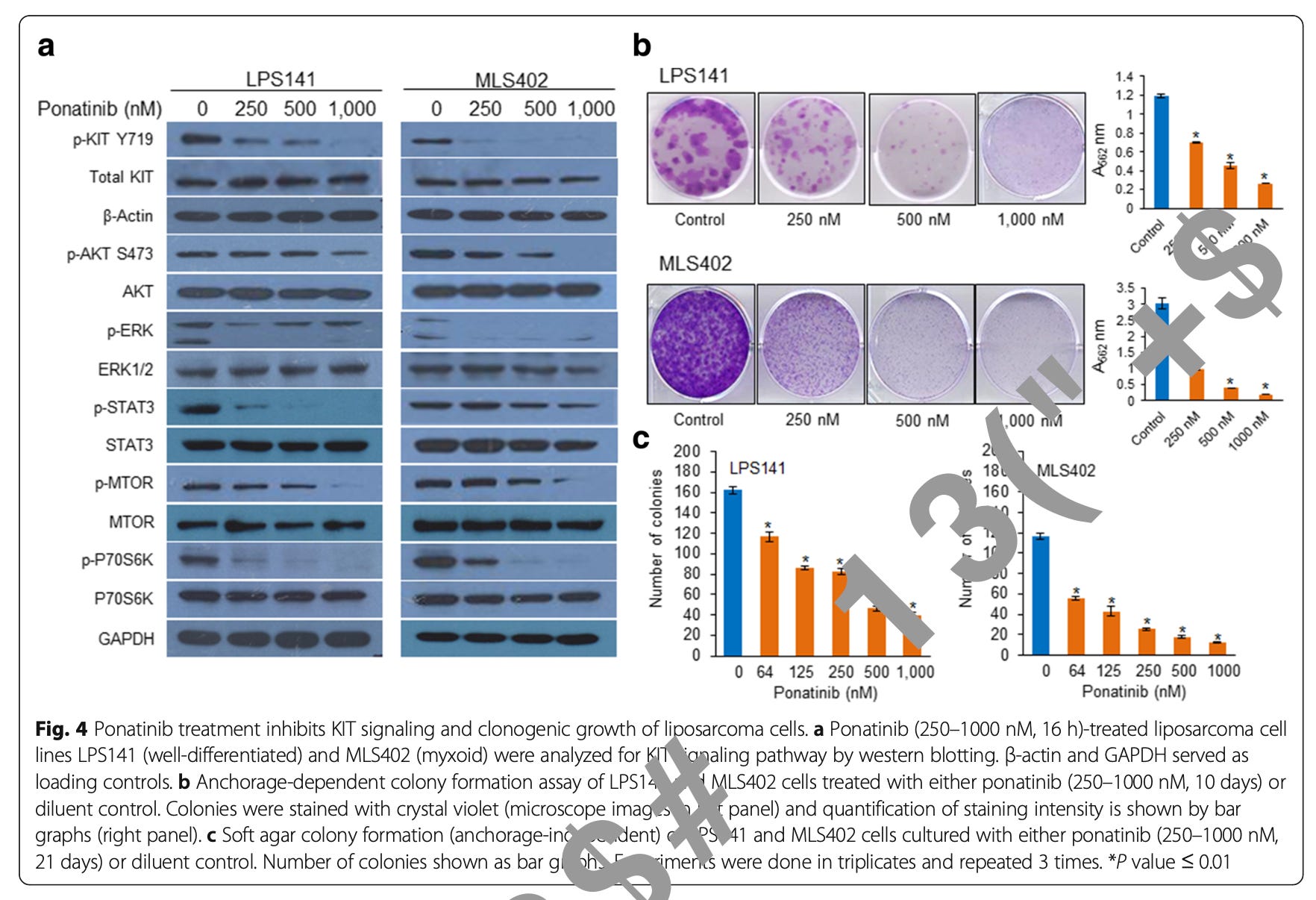
A paper by a group of NUS Cancer Science Institute researchers (and others), first published in 2017, was retracted in November after concerns were raised about image and data irregularities. None of the researchers involved in writing the paper responded to the publisher, the Journal of Hematology & Oncology, when these concerns were raised, according to the retraction notice. The paper was cited 31 times before it was retracted.
According to the journal, some of the concerns raised include the use of what appear to be duplicate images, as well as irregularities in data.
Image manipulation is one way that researchers falsify results, with duplicate images being one telltale sign of this taking place (here’s a fascinating discussion of it).
Of the study’s 10 authors, 4 were affiliated with the National University of Singapore’s Cancer Science Institute at the time of publishing.
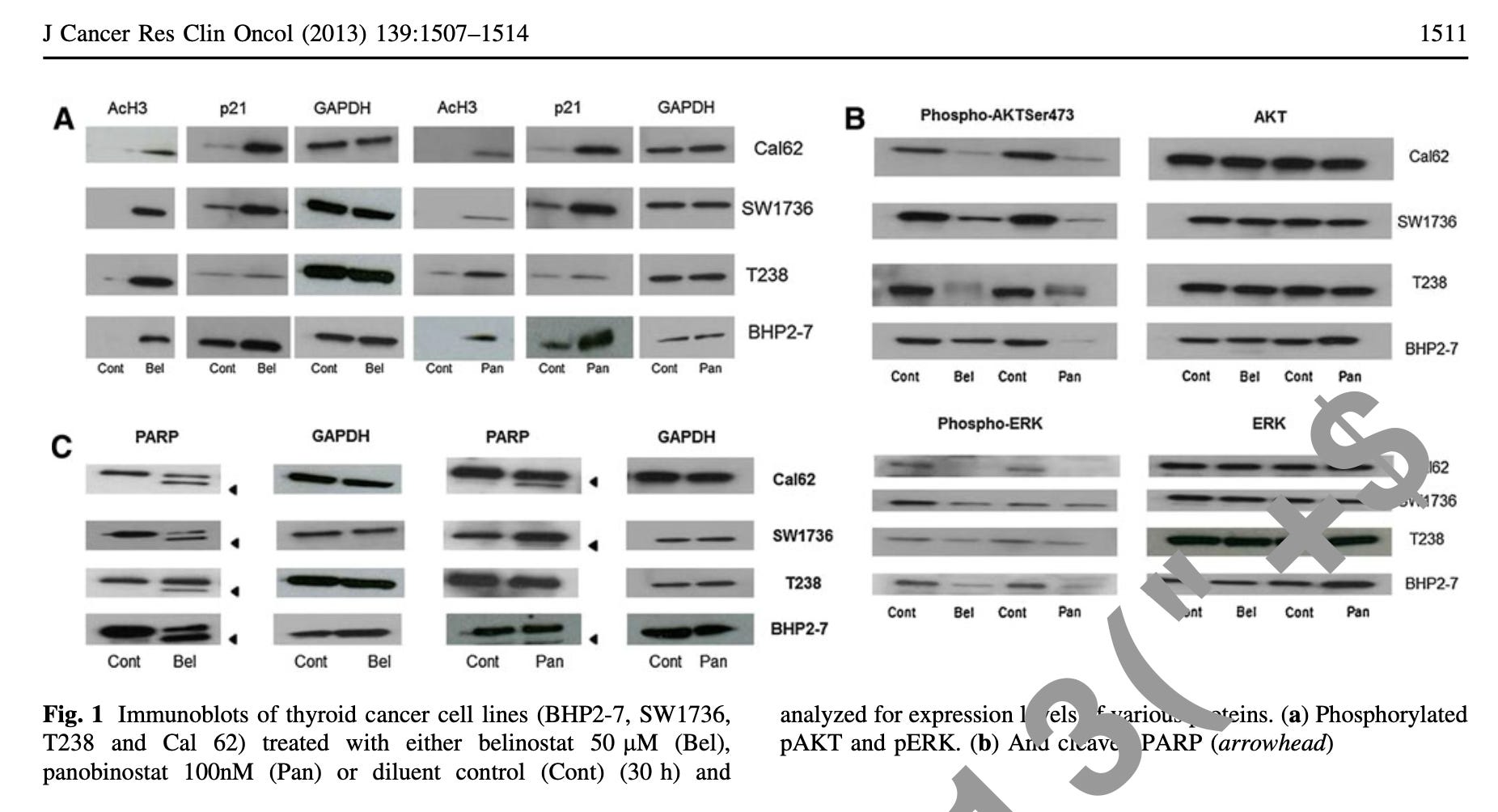
This isn’t the only case implicating an author from this group. In October, another paper also co-authored by Dr H. Phillip Koeffler (formerly of the Cancer Science Institute) was retracted by the Journal of Cancer Research and Clinical Oncology.
This paper, published in 2013 and examining thyroid cancer, also had concerns raised over highly similar images in the article. “Upon request, the authors stated that the raw data are no longer available due to the age of the article,” wrote the journal. “However, due to the number of concerns, the Editor-in-Chief no longer has confidence in the presented data.”
Two authors disagreed with the retraction, while the others (including Dr Koeffler) did not respond. The paper was cited 60 times before it was retracted.
More irregularities in cancer research
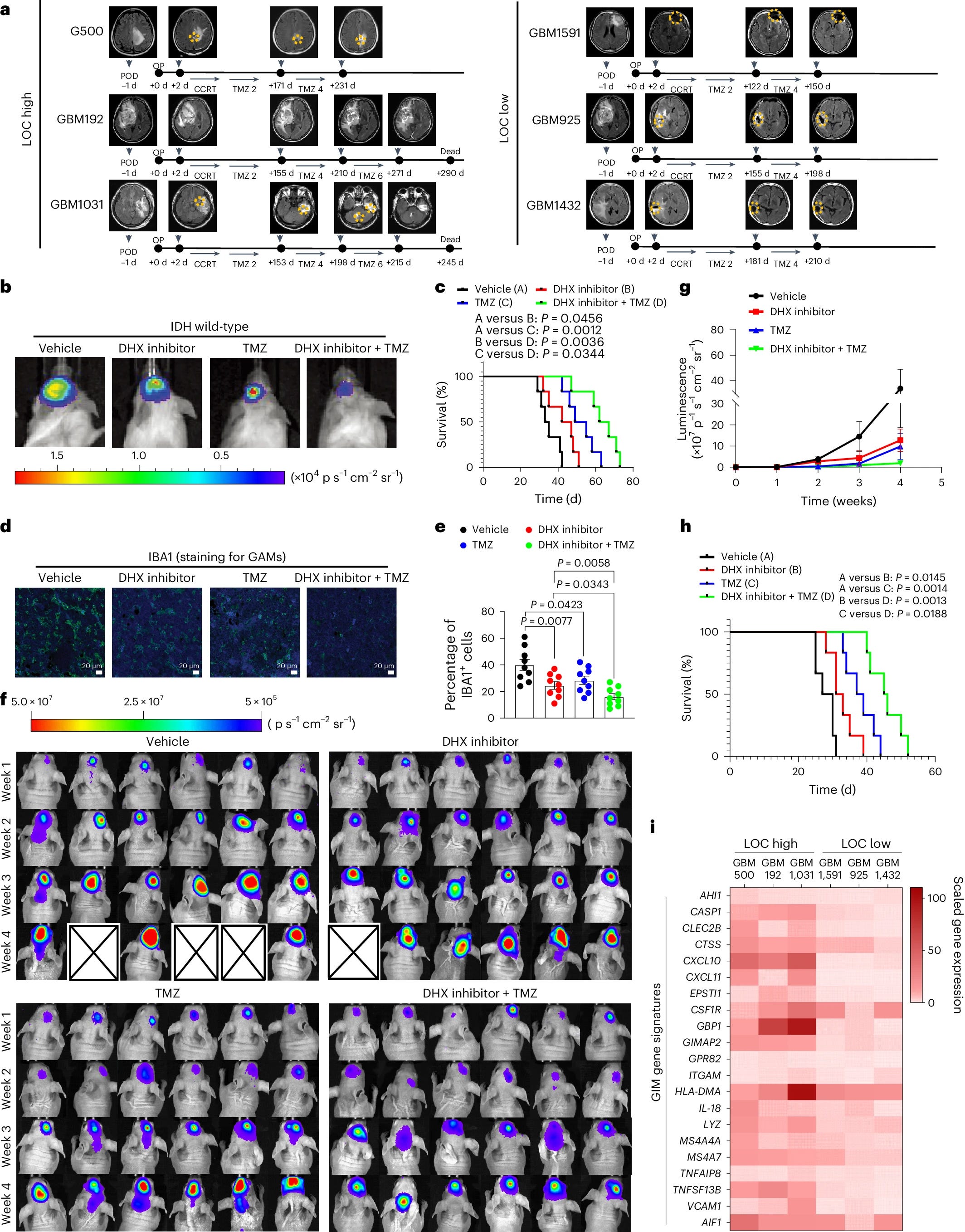
That’s not all for biomedical retractions this year. Here’s another paper, this one examining a form of brain cancer and published in 2024, that was retracted in January after concerns were raised over the images used, many of which bear similarities to each other – potentially indicating manipulation.
Of the 20 authors who co-wrote the article, 8 were affiliated with the Agency for Science Technology and Research (A*STAR). One of the paper’s four lead authors, Lele Wu, is a recipient of a career development award from A*STAR’s Institute of Molecular and Cell Biology and a young individual research grant from the National Medical Research Council, per their LinkedIn account.
Here’s part of the journal’s retraction notice:
The authors attribute image overlap and similarities to human error. Given the number of errors, however, they have lost confidence in the reliability of the study and therefore wish to retract the Article. The authors deeply regret these errors and sincerely apologise to the community. All authors agree to this retraction.
The article was cited 9 times before it was retracted.
One of over 1,500 articles retracted in paper mill investigation
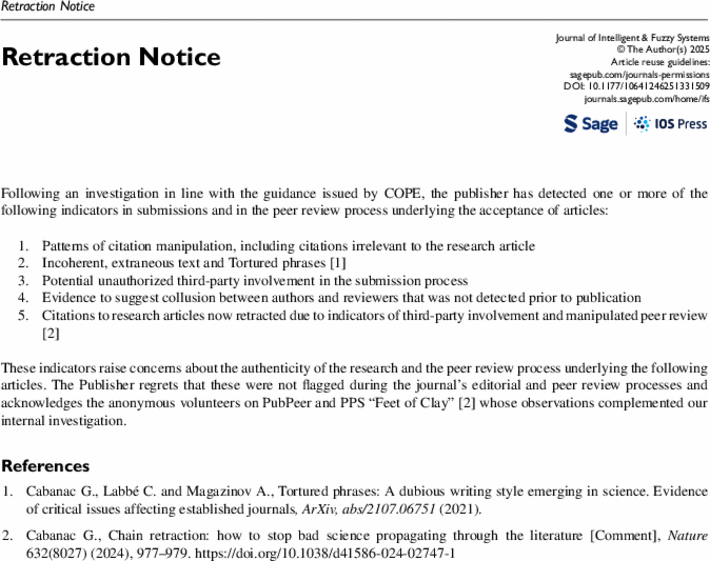
As part of an investigation by academic publisher Sage into one of its publications, the Journal of Intelligent and Fuzzy Systems, over 1,500 articles were retracted over “questionable peer review, citation manipulation, and other signs of paper mill activity”, according to Retraction Watch.
This mass retraction included three papers with authors affiliated with Singapore institutions at time of publishing. In these papers’ retraction notices, it states that there is “evidence to suggest collusion between authors and reviewers that was not detected prior to publication” as well as “patterns of citation manipulation”.
It’s honestly insane to me that this journal still exists when their most-cited article in the past three years was retracted, and 3 of the 13 things they put out in their latest volume were retraction notices.
Of the Singapore-affiliated authors involved, only one appears to hold a position (a cursory internet search suggests that the others are students). This person is Dr Mark Goh of the NUS Business School, who is also Director (Industry Research) at The Logistics Institute-Asia Pacific.
His retracted paper, co-authored with four others, was first published in 2017 and was cited 27 times before it was retracted in 2025.
Extreme and irrelevant self-citation
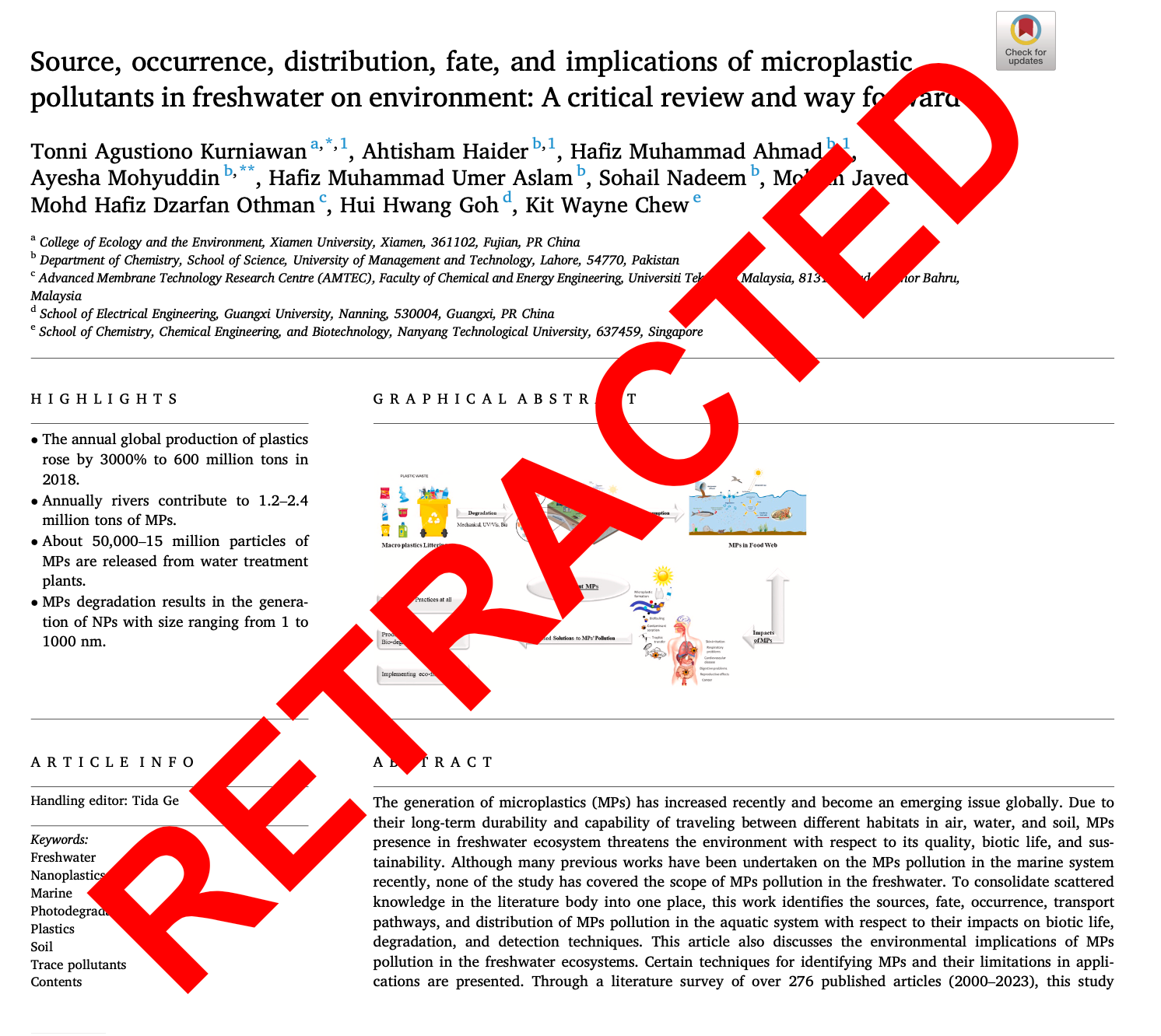
A literature review on microplastic pollutants in freshwater, first published in 2023, was retracted in June 2025 after concerns raised over self-citation by the lead author.
Of the paper’s 10 authors, only one was affiliated with a Singapore institution at the time of publishing, Dr Chew Kit Wayne, then an assistant professor at NTU. He is credited as the last author.
According to the journal’s retraction notice, the initially submitted paper included 25 citations to works by the paper’s first author, Dr Tonni Kurniawan, an associate professor at Xiamen University. 6 more citations were added as part of revisions.
“The assessing editor determined that of the total of 31 citations to corresponding author Tonni Kurniawan, around 85% are not relevant to the article,” writes the journal’s retraction notice. “This example of extreme self-citation of irrelevant articles represents a violation of publishing ethics and as such the Editor believes that the most responsible course of action is to retract the paper.”
The authors disagreed with the retraction. The paper was cited 127 times before it was retracted.
Notably, these authors have an insane publishing output. This is one of five papers by Dr Chew, who is now an assistant professor at the United Arab Emirates University, that have been retracted. This is a drop in the bucket considering how he has published over 260 articles since 2017.
Meanwhile, the lead author, Dr Tonni Kurniawan, has published over 490 articles.
The Singapore hall of infamy
Of course, these works don’t come anywhere close to the most glaring instances of retractions relating to Singapore.
Education researcher Dr Noel Chia Kok Hwee (formerly of NTU’s National Institute of Education), whose research primarily examines special needs children, has had 21 papers retracted by The Journal of the American Academy of Special Education Professionals in 2016 and 2017.
This came after an investigation by NTU into his work. Here’s a link to an archived version of the university’s statement, which states that the school conducted an in-depth investigation following allegations of research malpractice.
Another of his works was recently retracted in 2023, when an article about using avatars with individuals with autism spectrum disorder was pulled by the International Journal of Emerging Technology and Advanced Engineering.
Dr Chia appears to now be the managing principal therapist at Merlion Pediatric Therapy, where his profile states that he was a former Lee Kong Chian Research Fellow. Prior to the retractions, he appears to have regularly featured in the press sharing his thoughts on special needs children.
Also between 2015 and 2017, a misconduct investigation by NTU resulted in the firing of NTU professor Ravi Kambadur and his wife and co-author Mridula Sharma, as well as the revocation of two researchers’ doctorate degrees, after the group was found guilty of falsifying data. The Straits Times called it the “one of the biggest cases of scientific fraud in Singapore”.
The investigation resulted the retraction of six biomedical research papers, examining the potential of suppressing myostatin to burn fat.
Jumping ahead to 2023, nine papers were retracted after NTU lodged a complaint over a fictional author going by the name of “Toshiyuki Bangi”, who claimed to be affiliated with NTU’s School of Civil and Environmental Engineering.
This partly accounts for why 2023 saw such a large number of retractions for Singapore-affiliated authors – one of them was made up! Apparently, to make each coalition of authors appear more prestigious than it was to improve their odds at peer review, said NTU’s research integrity officer at the time.
Per Retraction Watch, the corresponding author for all of the papers was Cong Zhang, a researcher in the School of Environmental and Civil Engineering at Jiangnan University in China.