

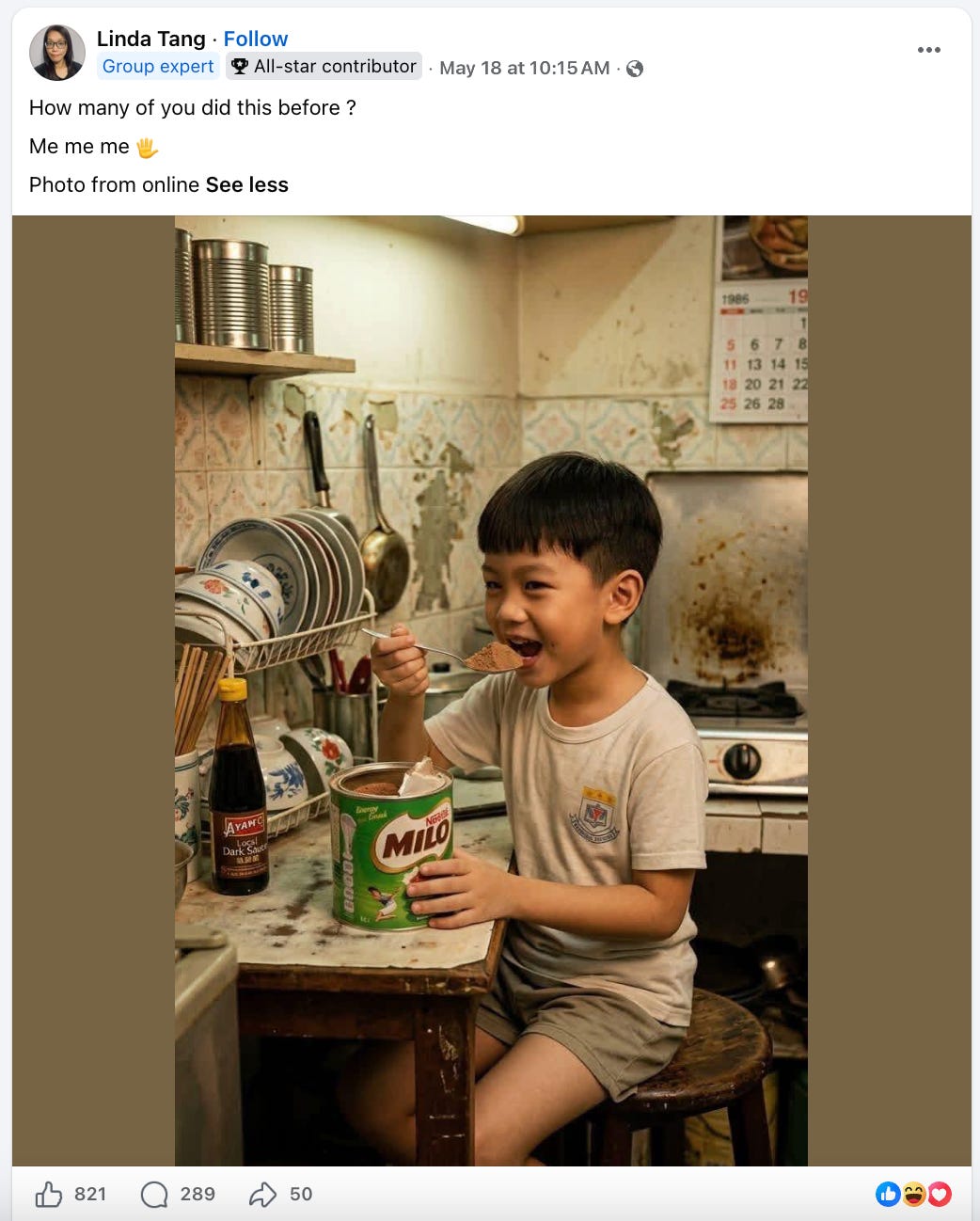
Take a look at Heritage SG Memories, the country’s largest Facebook group dedicated to history and heritage, and it seems like a good third or more of the content is in some way AI-generated now.
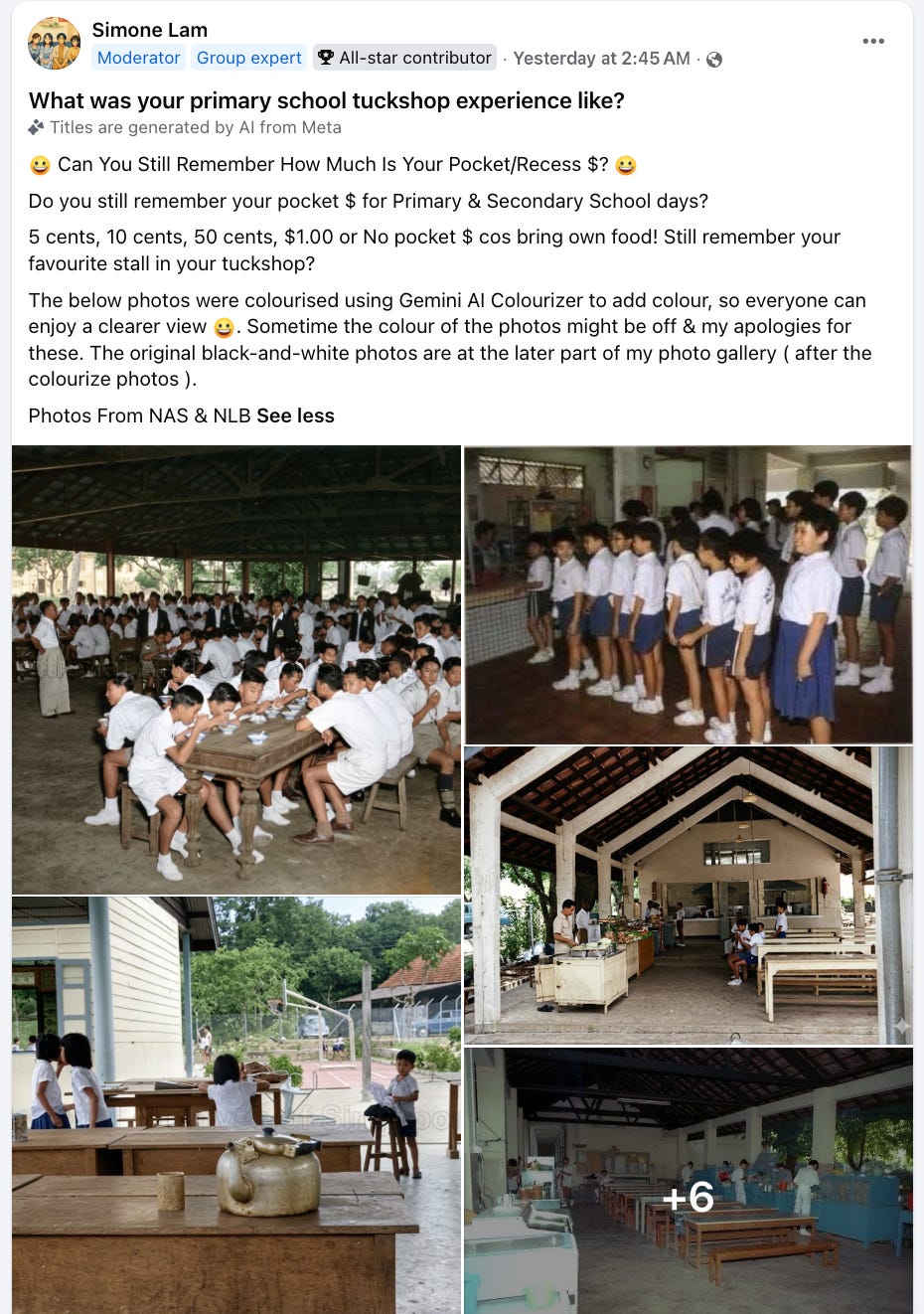
Some of it seems innocuous at first glance: users stating that they used Google’s Gemini to colourise old black and white photos they found in the National Archives.
Others are total and extremely obvious fabrications. AI-generated images that are often accompanied with captions that beckon the reader to share memories of a rosier past. Concerningly, most users either don’t realise or don’t care.
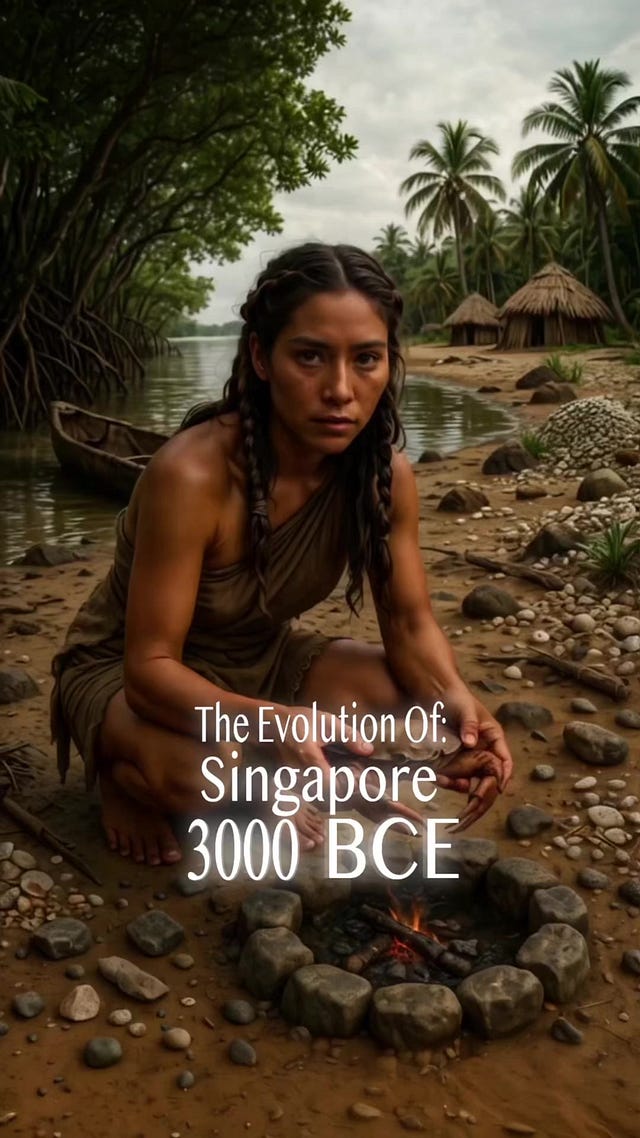
Cast your gaze towards TikTok and the AI content gets much weirder. Case in point:
 Tiktok failed to load.
Enable 3rd party cookies or use another browser
Historyogi, the man behind the popular history-focused TikTok account and podcast of the same name, tells me: “It’s become a huge problem on Facebook and Instagram. It’s mostly boomers using AI to alter or generate entirely fake images. Even the accompanying text is AI.”
When he comments stating that it’s AI and explaining that colourising photos in this way risks introducing inaccuracies – or that AI-generated summaries often over-simplify for the sake of getting all the text into a single Instagram slide – there are typically few receptive responses.
“They just like the nostalgia,” he says.
This longing for a Singapore that never existed puts on display the increasingly strange hollowness of engaging with heritage content in Singapore, where the past serves a very specific purpose (nostalgia farming) and the substance of history is nearly always secondary to the aesthetic of an (AI-)imagined Singapore.
Nostalgia farming for boomers
Boomers aren’t the only ones who are into AI slop, but there’s one big reason for why older Singaporeans are particularly susceptible: it appears that they mostly exist outside of “woke” debates about AI and are thus often totally unaware or uncaring towards the ethical risks and technical failures of the technology. I’m using the term boomer broadly here, to refer to those middle-aged and up.
A survey conducted by AsiaOne and published last week finds that under 35s are the most pessimistic about AI – while those aged 35 and up tend to rate it as having a more positive impact on “convenience”, “individual expression”, and “thinking and reasoning”. The group that reports the most frequent usage of AI are those aged 35 to 55.
When riding a train or bus in Singapore, it has become an increasingly common experience to overhear someone listening to the distinctively robotic cadence of an AI-generated TikTok video. And every time I look over to see who’s causing the commotion, it’s always an elderly commuter.
Such boomerism extends to the family group chats awash with AI-generated images and emojis sent by older relatives, and the flood of AI-generated text taking over the emails of senior leadership across Singapore’s companies. All of this indicates an uncritical embrace of the technology as a fancy new bauble rather than a potential source of harm.
One might ask: but what’s so harmful about using AI to colourise black and white photos?
Putting aside the immense environmental cost of the technology (global AI demand is projected to account for half of the UK’s water withdrawal in 2027), generative AI tools have a terrible track record with accuracy because of how the technology works.
Think of it as a probabilistic auto-complete. Generative AI is trained on a large amount of data, which it then uses to decide how it should respond to a user’s query.
Flaws in this underlying training data are why AI tools often generate images that reinforce stereotypes. There are simply fewer instances of contrary images in the stock photos and other images that make up AI’s training data. A lot of this has to do with the origins of the technology. Companies take whatever happens to be online and available — at times, copyrighted material used without consent and child sexual abuse material — to train their models. The emphasis is on scale and convenience, not how representative such data is of reality.
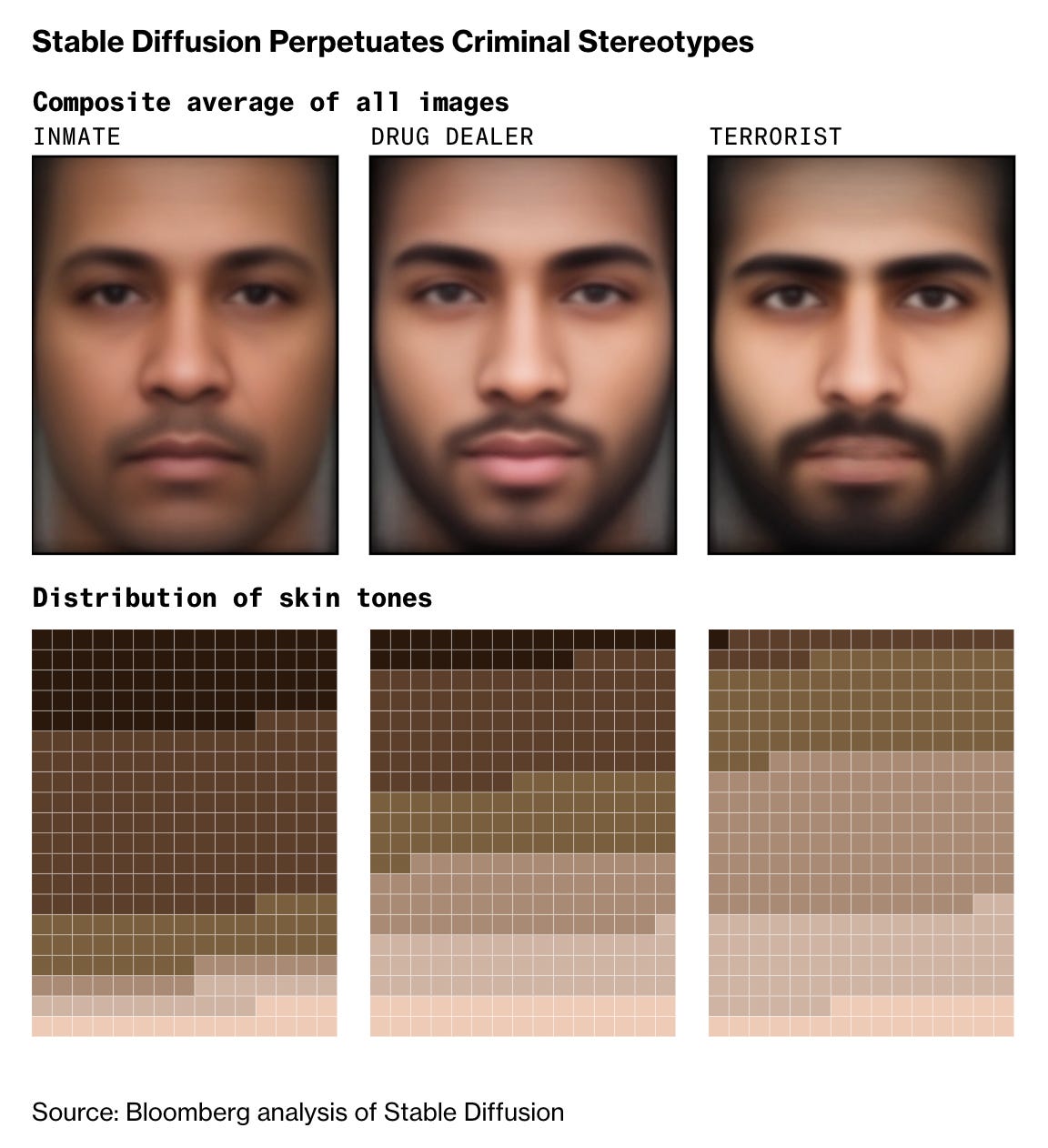
One 2023 experiment with generative AI tool Midjourney found that the tool had difficulty generating even simple images of African doctors without wildlife or caricatures. To get a sense of just how little control an AI model’s creator has over its outputs, in 2024, Google’s attempt at correcting this race bias resulted in the tool generating ahistorical images of Black nazis and Asian vikings. AI is not only a black box that is often indecipherable even to the most savvy, it’s also a black box built with dubious materials.
The flatness of AI history
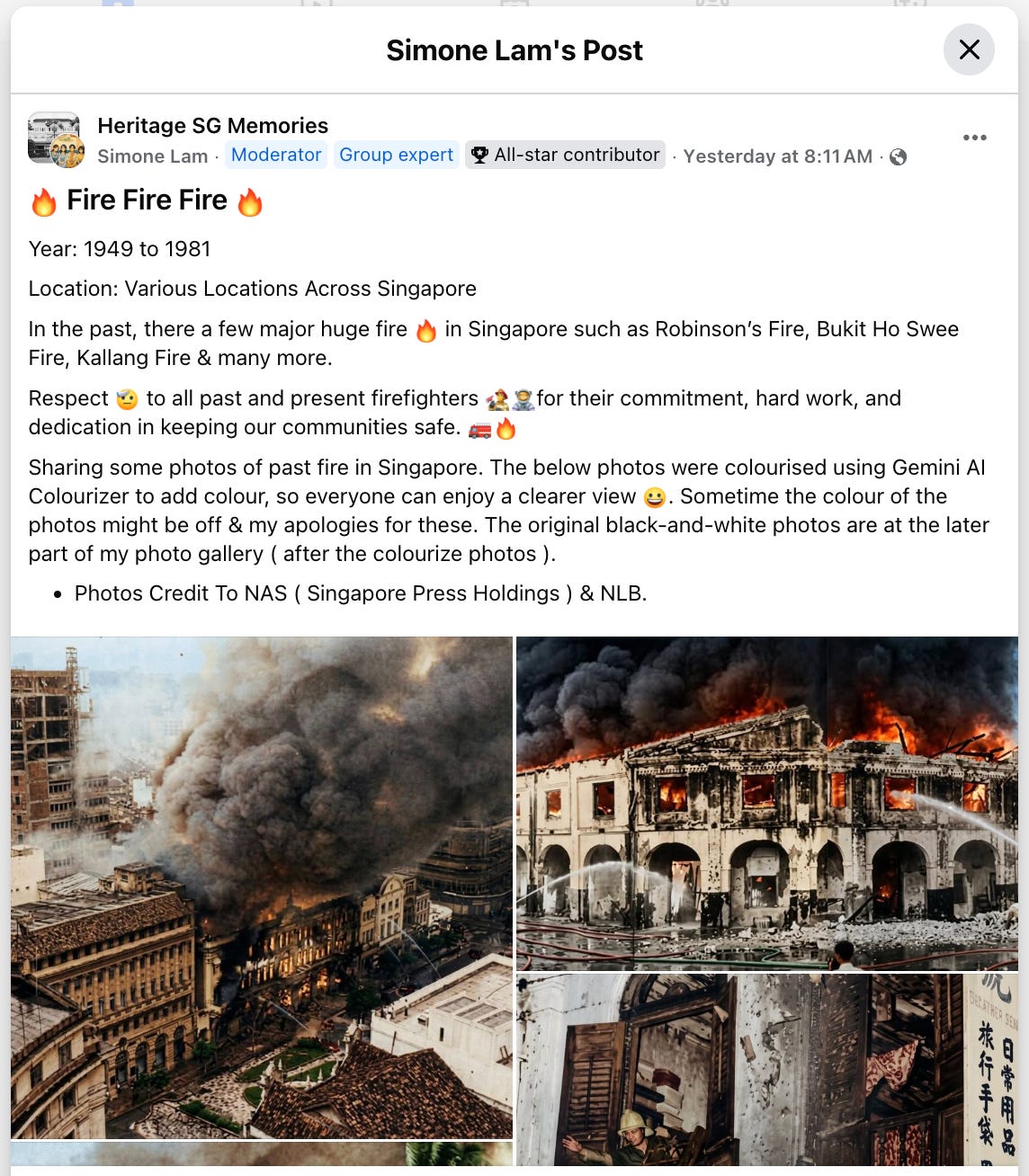
All of this is why even the act of colourising photos using AI is less innocuous than it seems. Take a look at the outputs of Gemini’s colourisation on Heritage SG Memories, and one notices that the tool tends to paint everyone in the same shade of sun-tanned skin – in the same racially ambiguous hues. It’s a level of homogeneity that stands out considering Singapore’s multiculturalism.
When colourising, generative AI doesn’t apply long-used colourisation techniques, it generates what a historical image of an Asian country should look like based on its training data. Notice how the AI-colourised images of Singapore’s past also tend to have this washed out and sepia-toned colour to them, because that is the colour tone synonymous with the past in popular imagery.

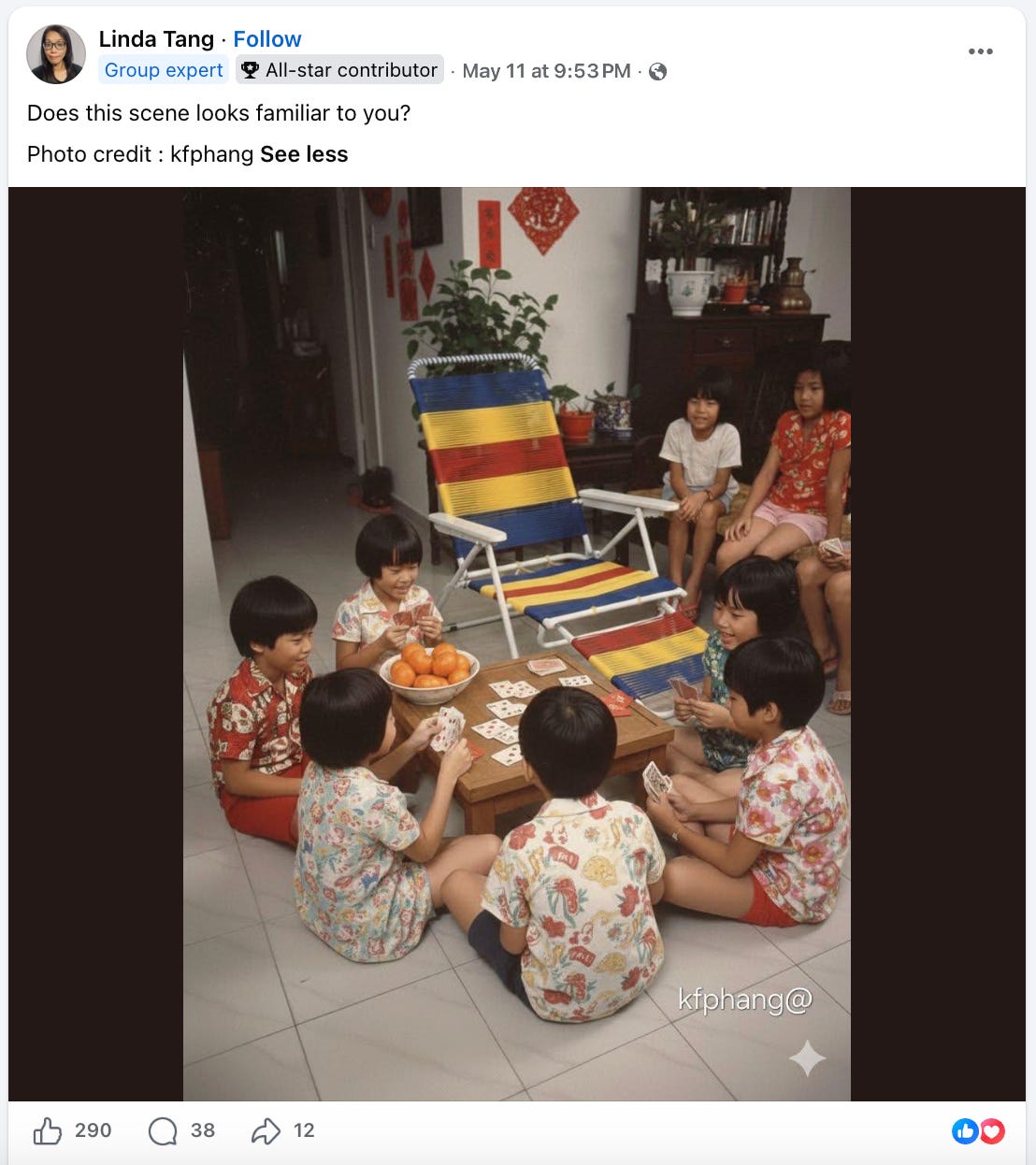
The same goes for images that are entirely fabricated, that have so many of these uncanny touches that come across like it was composed by an alien who is learning about human life secondhand, but has never seen it themselves.
Everyone tends to look the same, with very little variation – the same haircuts, the same skin tones, the same expressions. There’s always the out of place furniture, the impossible angles, and the inexplicable activities.
I think one of the worst consequences of the prevalence of such AI generation is that over the course of writing this, it has become difficult for me to tell if posts are merely colourised edits of actual photos of real history, or total fabrications. We can no longer trust the evidence of our eyes, even on boomer-frequented Facebook groups, because the boomers can’t stop making AI-generated history slop.
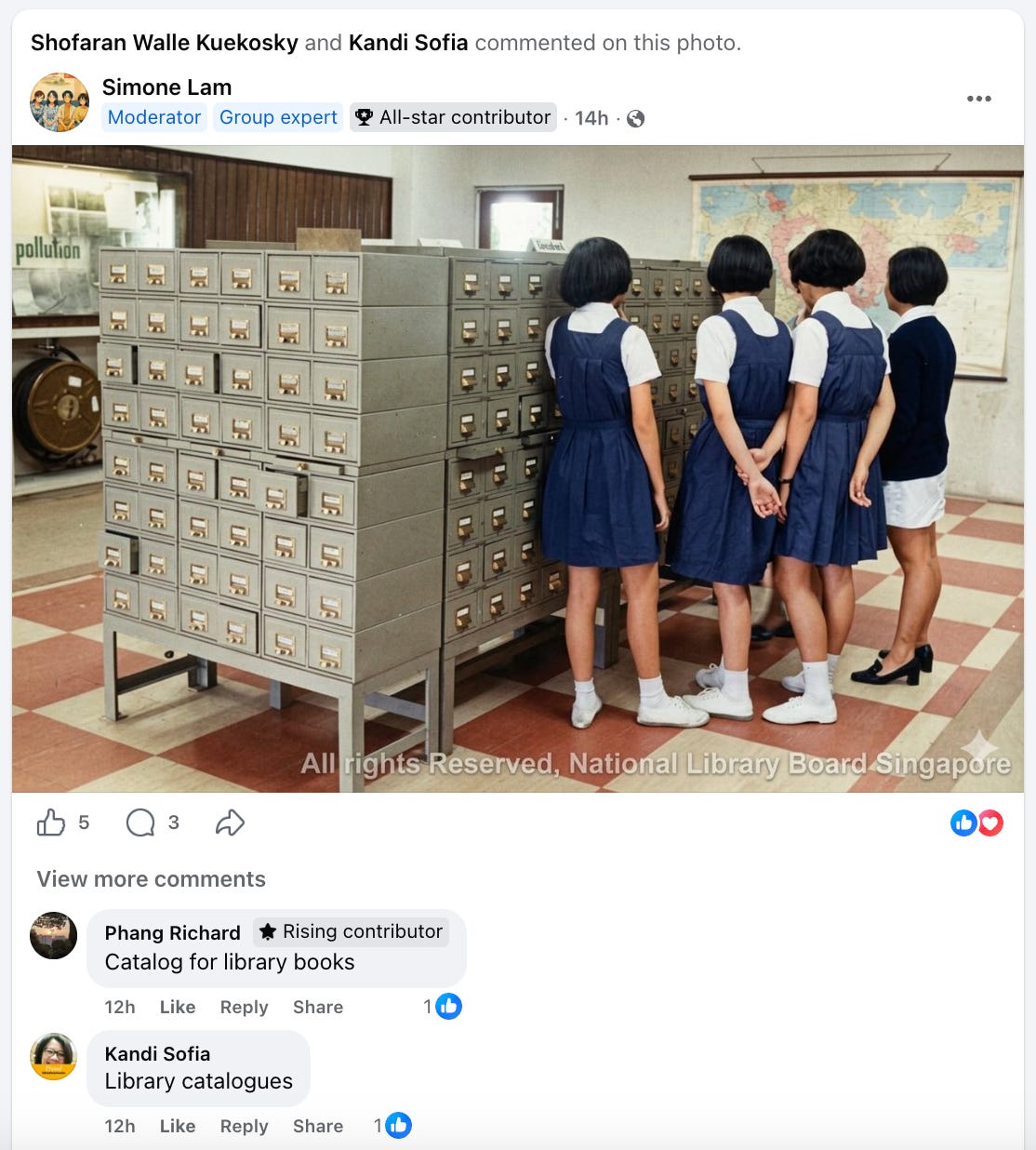
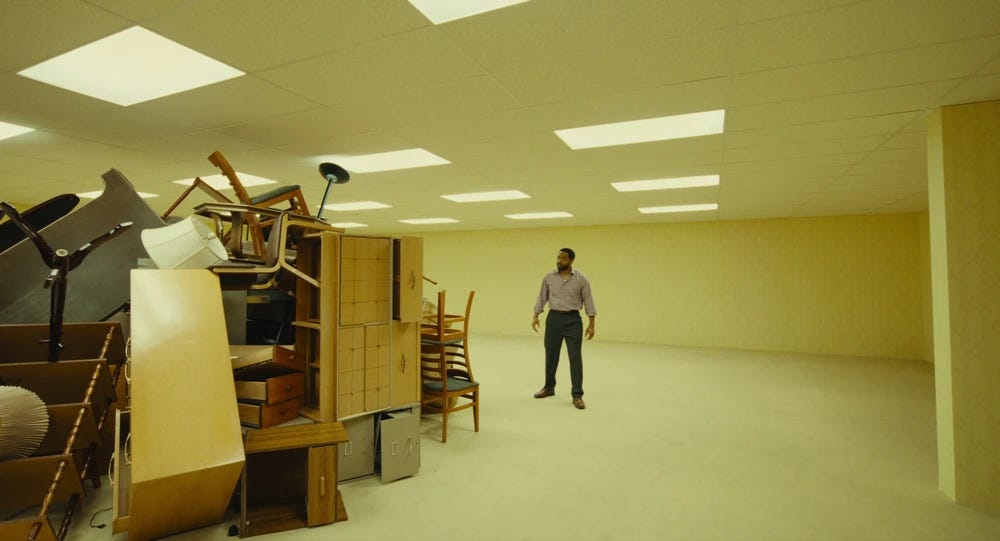
I find it so fitting that recent horror films Backrooms and Obsession – the most Gen Z coded pieces of horror media that have ever existed – make for such apt metaphors for AI’s uncanniness and its sycophancy. So much of horror media that originates from internet culture is preoccupied with the existential horror of digital technology. It’s therefore really unsurprising to me that the generation that grew up with analog horror often misses the everyday horror of AI. Boomers are so often preoccupied with whether they can, they rarely stop to ponder whether they should.
None of these AI-related errors are unique to Singapore, by the way. Folks have been calling attention to the dangers of AI-generated historical images for a while now. And AI-generated history videos have become a persistent genre on YouTube, to the point that it’s drowning out content from real creators.
It’s especially concerning because such content, produced at scale, often has little regard for accuracy. But then again, accuracy was never really the point.
AI’s place in the content machine
Even before the rise of AI-generated slop, many content creators have cottoned on to how there exists a significant audience for footage and pictures of Singapore’s past. The fast pace of change in Singapore means that often, such footage is all that remains of some of the country’s most significant places and historical moments.
One of the first articles I wrote for The Straits Times was about the content creators bringing Singapore history to life on TikTok. However, the niche and genuinely educational history content that exists is in the minority, and is vastly outpaced by what I’d call nostalgia farming: minimally edited clips of things and places that no longer exist, flattening the past into an uncomplicated and rosy narrative where things were simply better.
 Tiktok failed to load.
Enable 3rd party cookies or use another browser
What is social media for? If you answered that it’s for socialising, you’re missing much of the point. Social media is for advertising. Social media algorithms aim to maximise your engagement with the platform to serve you the maximum amount of ads possible for optimal profits. Engagement at all costs has enabled everything from genocide to the rise of terms like ragebait, brainrot and doomscrolling in our cultural lexicon.
Seen through this lens, nostalgia’s place in the social media machine has always been about emotively appealing to viewers to extend their time on a platform.
But, such content is itself a finite resource. There are only so many images of great fires and big city cleanups. There are only so many street names to explain or historical tidbits to expand on, and only so many ways to remix and edit existing footage. There is simply not enough to feed the endless content machine that is social media.
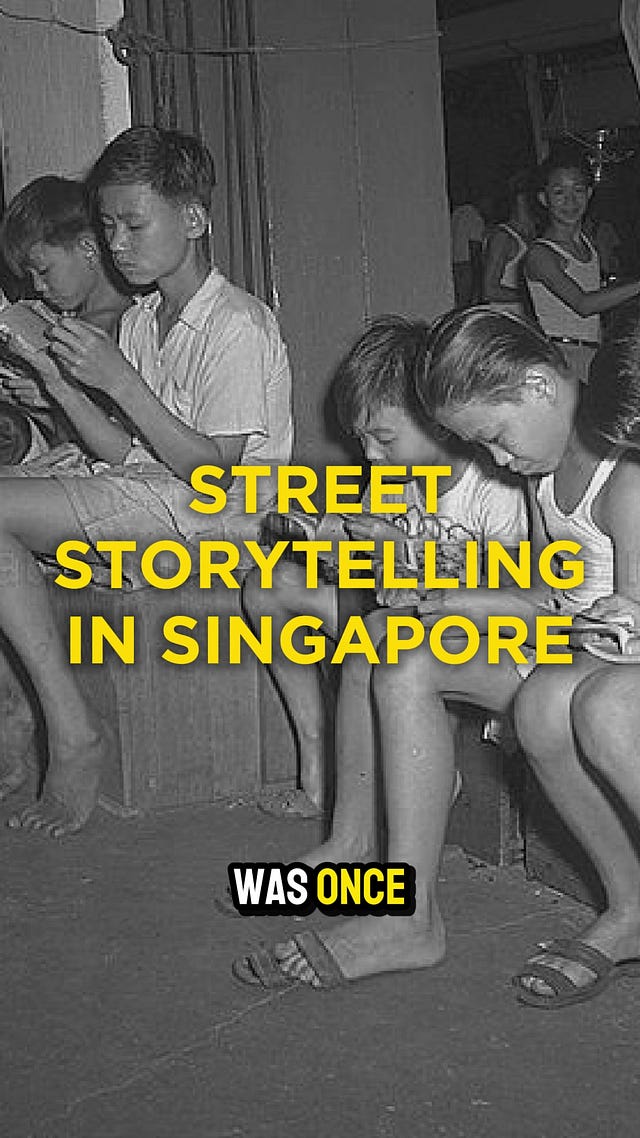
Is it any wonder then that artificial intelligence has become the latest frontier for mining history for nostalgia?
 Tiktok failed to load.
Enable 3rd party cookies or use another browser
Unlike even the nostalgia farming clips of old though, AI’s sycophantic and trope-driven nature means that it generates imagery that is even more unsurprising, unchallenging, and uncomplicated. I think that it’s often best to think of AI as a machine for tropes, rather than a machine for creativity. Add to that the human who generates these images likely filtering out source material and inconvenient outputs that complicate the narrative of a nostalgic past (while likely relying on AI to script said narrative), and we get the hollowing out of Singapore history for the masses.
What we’re losing to AI-generated history
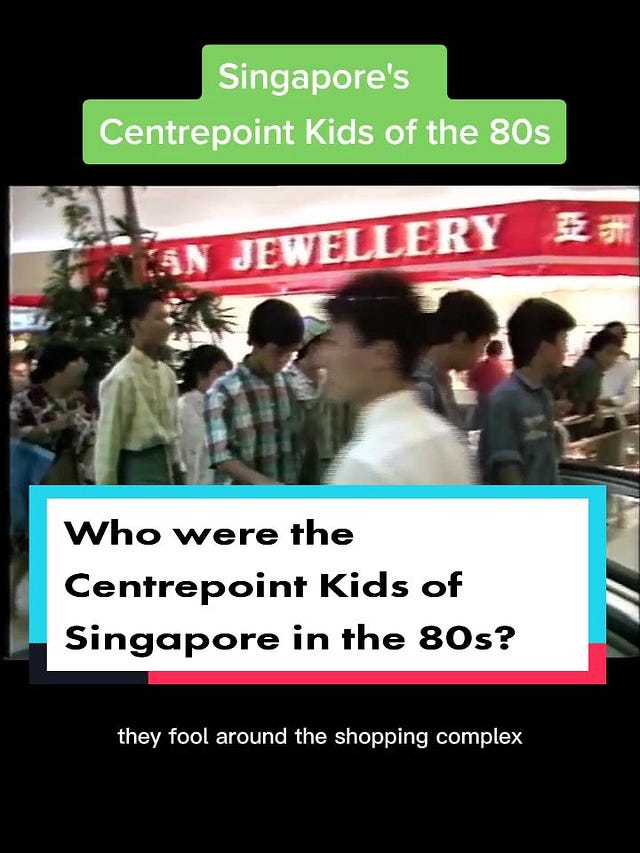
One of my favourite videos shared by Historyogi is this footage of Singapore’s Centrepoint Kids, mall rats that loitered around the Orchard Centerpoint mall and sparked a media moral panic over the teen pop/punk culture of the 80s.
 Tiktok failed to load.
Enable 3rd party cookies or use another browser
“Sociologists would tell you that they are the byproducts of a pop culture, that they draw their inspiration from music, dancing and fashion,” says a newsreader.
“Critics though would call them punks and say they are typical of a generation whose hallmarks are aggression, promiscuity, and aimlessness. An ‘all dressed up but nowhere to go’ generation.” One Centerpoint Kid interviewed says: “It’s not true that we come here to do bad things!”
It’s such a fascinating and surprising glimpse into how Singapore has always been annoyed about and irrationally fearful towards the antics of its youngest generations. It also complicates the narrative that the past has always been rosier, when it was always painted in so many different hues.
And there’s something so real about teens talking about how they just want somewhere that they can hang out in air-conditioning. One teen interviewed says: “At home, I feel bored. Especially when I’ve got no brothers and sisters, so I come here, make friends, joke, talk.” Another teen says: “When we dance, we forget everything.”
When I see these faces, I cannot help but wonder where they are now. Who is this diva with the purple dyed hair? It’s a feeling I never have when looking at something AI-generated, which could never embody the cringe, the drama, the mundanity, the stupidity, the yearning, the messiness, that defines so many moments of history.
All of this is hardly high effort content. It’s reposting with minimal editing an entire clip that was broadcast in the news, without even attributing the source.
 Tiktok failed to load.
Enable 3rd party cookies or use another browser
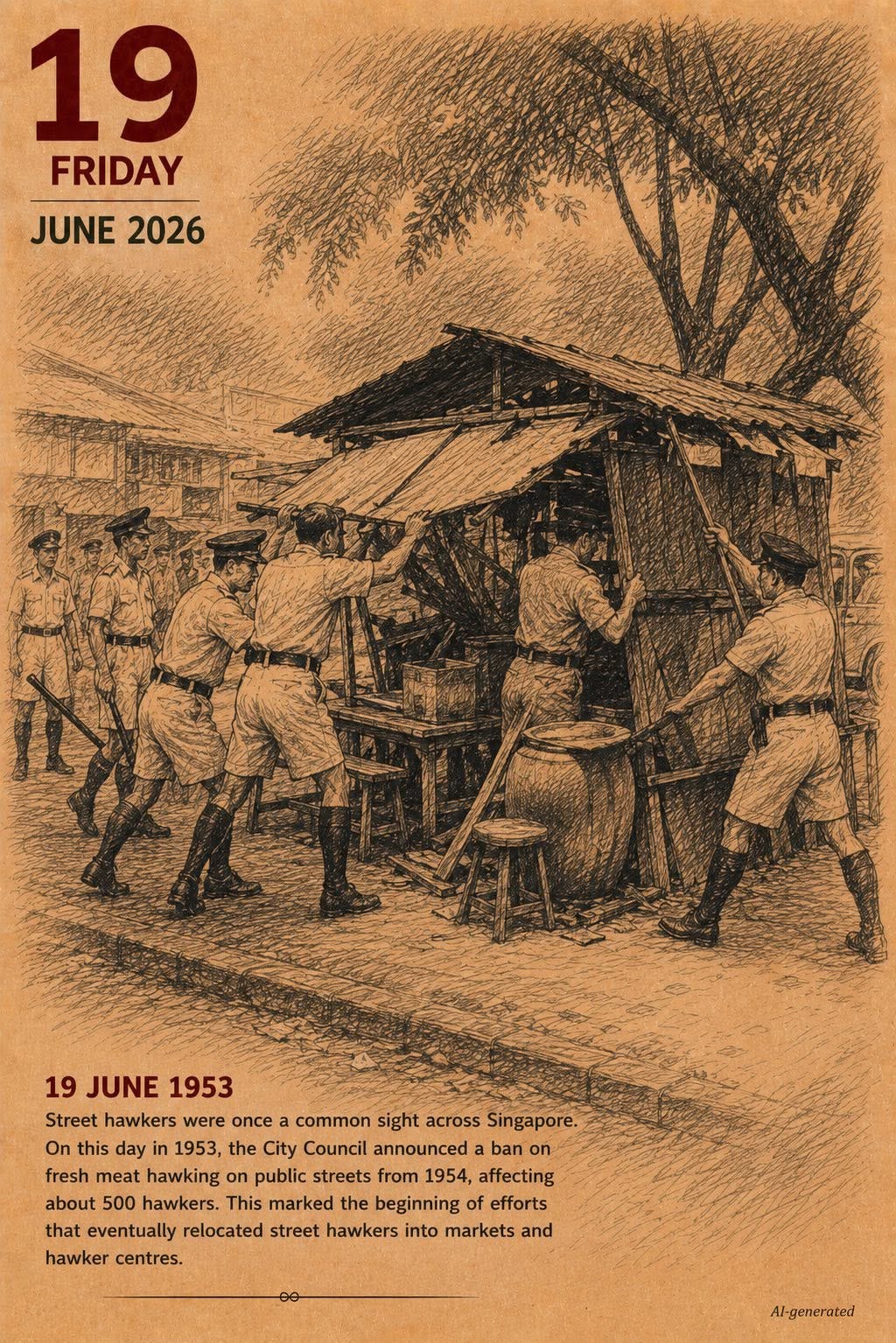
And yet, this is what we stand to lose when AI heritage slop (see the clip above) starts drowning out real history. When the prevalence of AI content means we can no longer trust the evidence of our own eyes. When real people and moments are less important than the retro aesthetic that they represent.
The saddest thing of all is that many of the boomers (and non-boomers) embracing this trend don’t realise that by putting the past through the prism of AI, they render it even less intelligible, even less real, and even further beyond their reach.
What stayed with me was your point that the goal isn't really history anymore, but nostalgia. I liked how you showed that AI doesn't just introduce factual errors. It can also flatten the past into something more familiar, predictable, and emotionally satisfying than it actually was. That felt like the deeper concern running through the piece. Thanks for sharing this.
I'd recommend reading Karen Hao's Empire of AI and Kate Crawford's Atlas of AI. Unpacks the myth of AI.