

Three years after the demise of the Social Development Network, it looks like a new government-run matchmaker is back on the cards for Singapore.
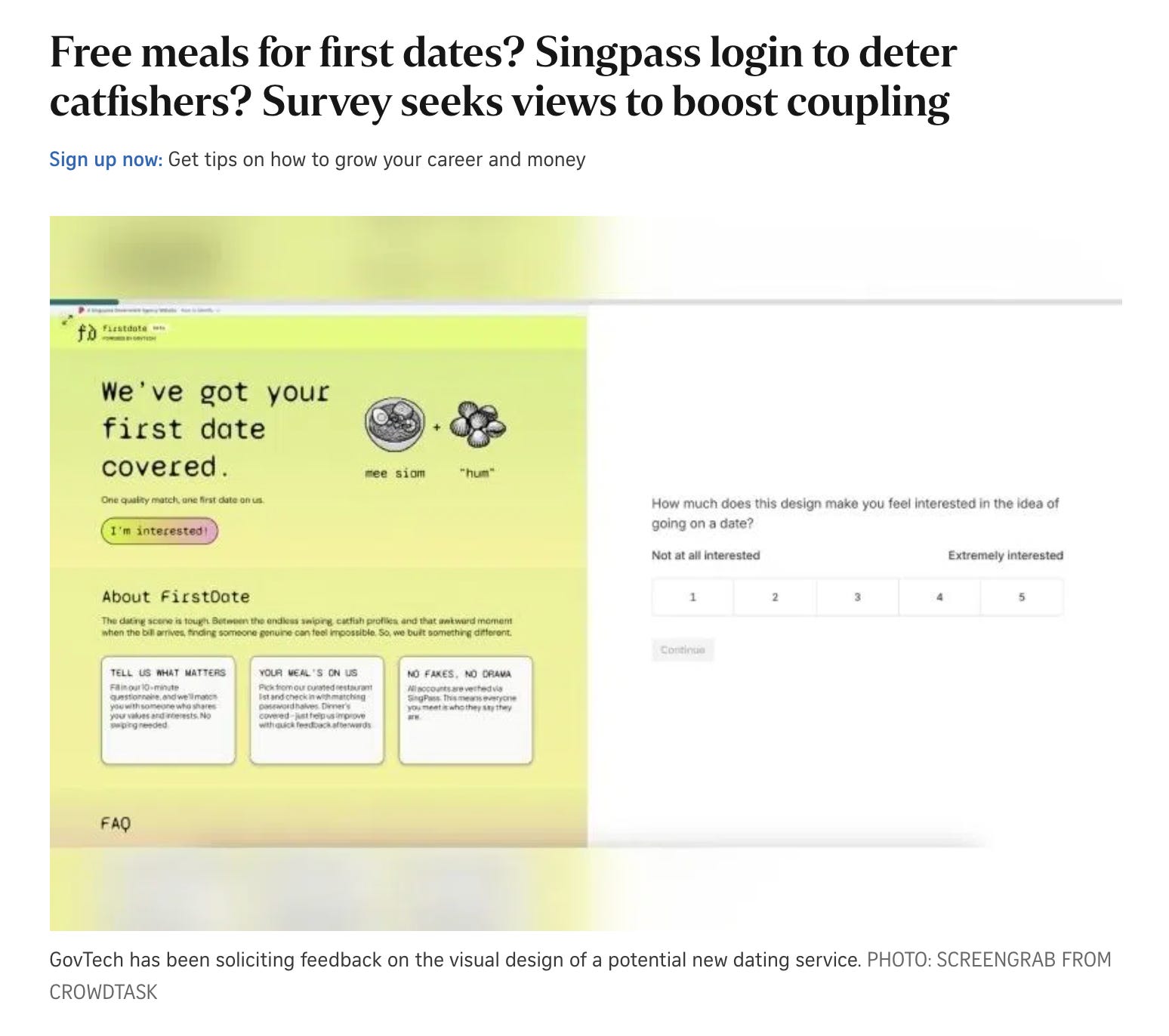
Earlier this month, a pilot progamme by GovTech called FirstDate was announced, with government workers set to be the first batch of daters. If this sounds familiar, that’s because I was the first to report on GovTech testing the waters with this idea all the way back in April for The Straits Times.


How will the matchmaking work? What questions are even in the matchmaking questionnaire? (Read on for the full list)
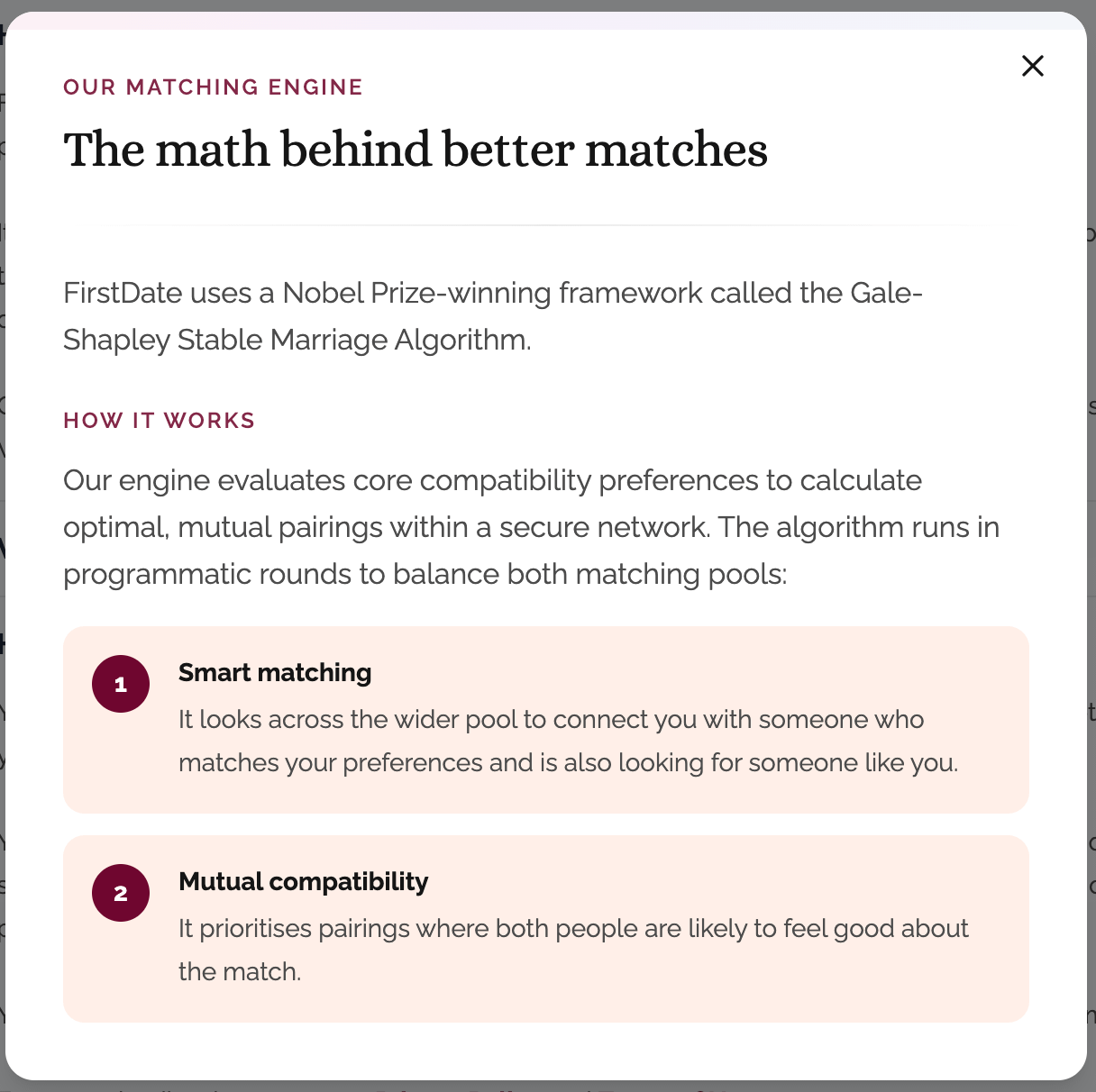
On FirstDate’s website, one line stands out: “FirstDate uses a Nobel prize-winning framework called the Gale-Shapley Stable Marriage Algorithm”. It’s a brow-raising detail because, despite the name, the algorithm has almost nothing to do with marriage, but more on this later.
The dating service will use Singpass to verify the identity of users, match people in cycles (you get only one match each cycle), and share contact details only when both users agree to their match.
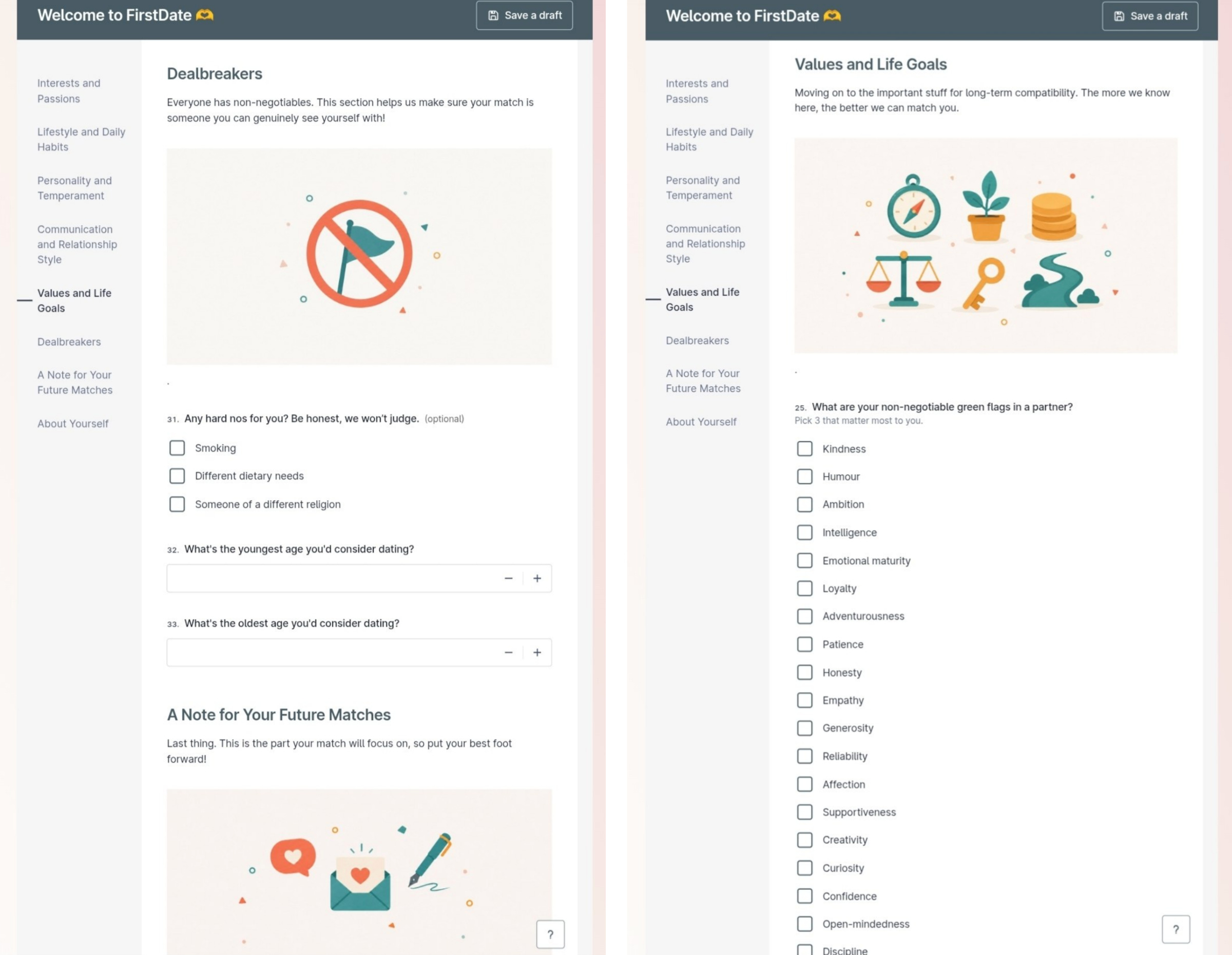
To get a sense of how the matchmaking works, here’s the questionnaire that the government workers signing up must fill out. The questions are a mix of close-ended and open-ended ones, across 8 categories, spanning topics like interests and passions, lifestyle and daily habits, and communication and relationship style.
These are the questions:
What are you into these days? (pick up to 5 out of a checklist of items like gaming, film and cinema, volunteering, cafe-hopping, etc)
Now, spill! What do you actually love about your hobbies? (open-ended, optional)
What cuisines do you eat on repeat and never get sick of? (pick up to 3 out of a checklist)
Which restaurant do you keep going back to and why? (open-ended, optional)
How often do you find an excuse to leave the country? (close-ended, with options like every chance I get (4+ trips a year) to I prefer staying in Singapore (never))
What kind of traveler are you, really? (close-ended, with options like adventure junkie, culture seeker, and I don’t travel much)
What’s a country that’s ruined all other countries for you? (open-ended, optional)
Team sunrise, or team “it’s 2am and I’m still up”? (close-ended)
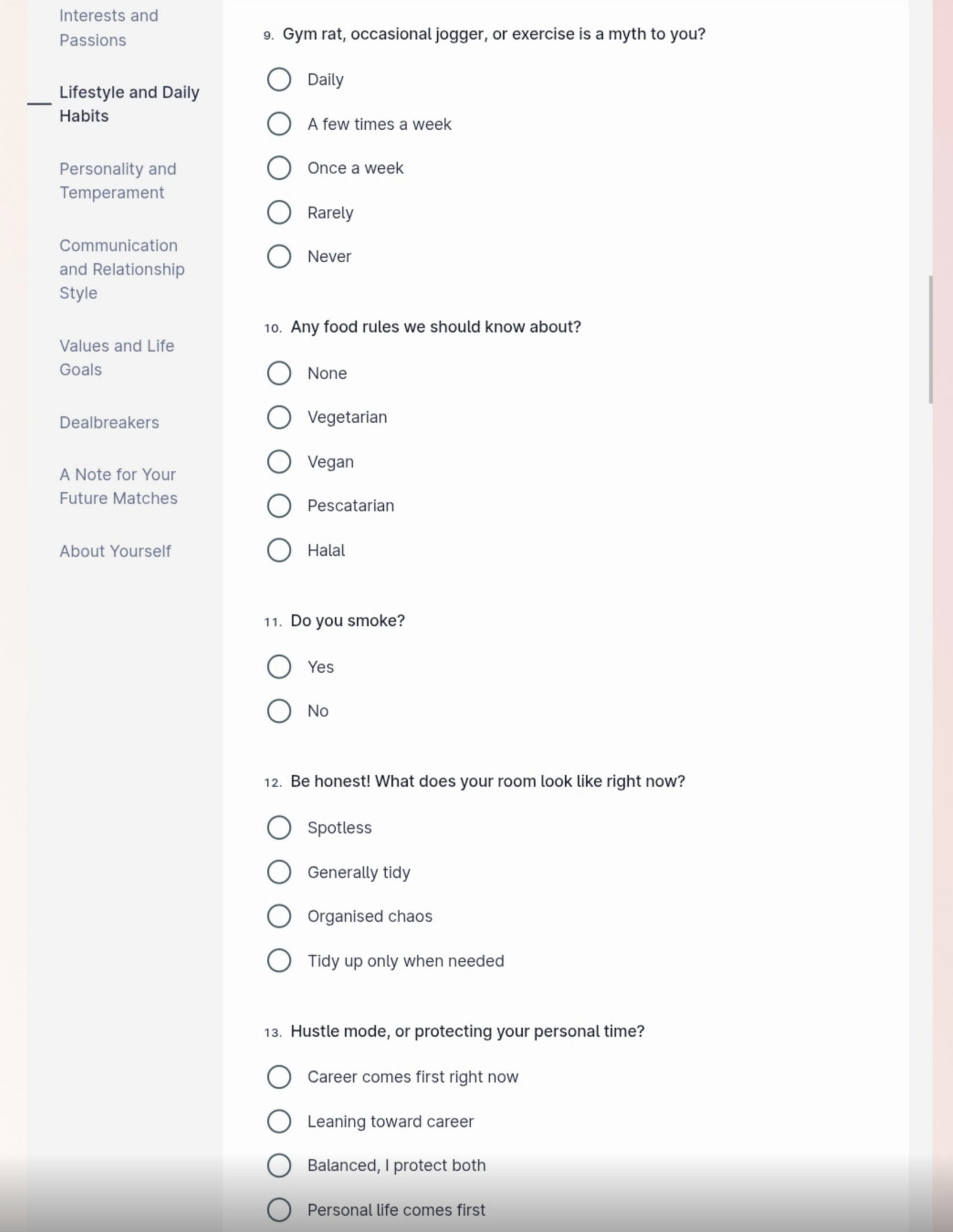
Gym rat, occasional jogger, or exercise is a myth to you? (close-ended)
Any food rules we should know about? (close-ended, with options like vegetarian, pescatarian, halal)
Do you smoke? (close-ended)
Be honest! What does your room look like right now? (close-ended, with options like spotless, organised chaos, and tidy up only when needed)
Hustle mode, or protecting your personal time? (close-ended, with options like career comes first right now and personal life comes first)
Real talk. How much of your day disappears into your phone? (close-ended)
Describe your social energy. Are you the life of the party, or the one who left an hour ago? (close-ended)
How important is it for you that a match brings the same energy, or do opposites attract for you? (close-ended)
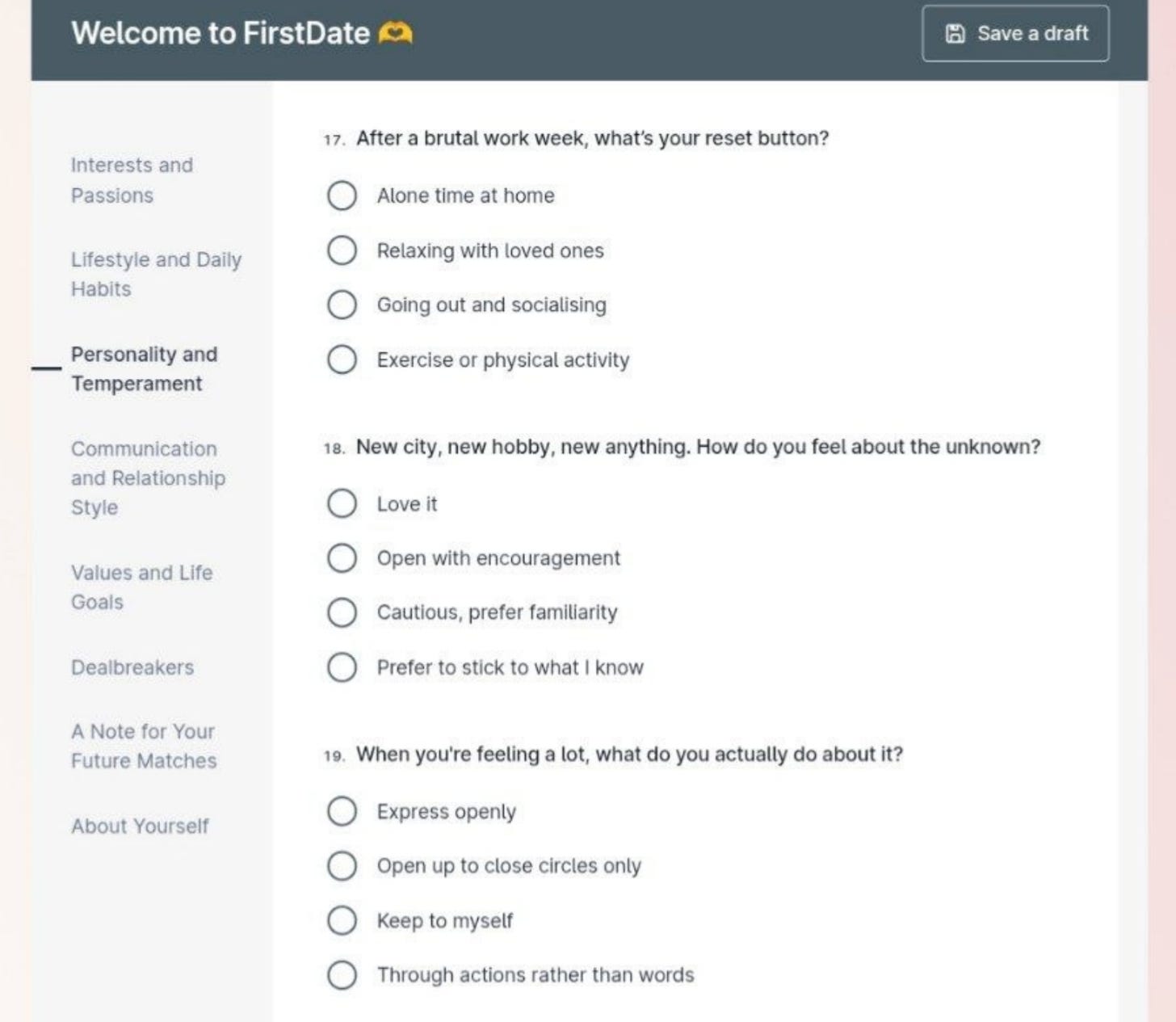
After a brutal work week, what’s your reset button? (close-ended, with options like alone time at home and going out and socialising)
New city, new hobby, new anything. How do you feel about the unknown? (close-ended, with options like love it and prefer to stick to what I know)
When you’re feeling a lot, what do you actually do about it? (close-ended, with options like express openly and through actions rather than words)
How do you like to be loved? (close-ended, pick up to three, with the five love languages as options)
How do you express love? (close-ended, pick up to three, also with the five love languages as options)
Non-stop texting, or comfortable silence. Where do you land? (close-ended)
Mid-disagreement, what’s your gut instinct? (close-ended)
Paint us a picture. What does your dream first date look like? (open-ended, optional)
What are your non-negotiable green flags in a partner? (pick 3 that matter most to you, out of options like kindness, humour, and honesty)
Are you always working on yourself, or is “good enough” good enough? (close-ended)
Do you see yourself having children? (close-ended, with options like yes, open to it, and definitely not)
Saver, spender, or “I’ll figure it out eventually”? (close-ended)
What’s your religion, if any? (close-ended)
Any hard nos for you? Be honest, we won’t judge. (close-ended, optional, with options like smoking, different dietary needs, and someone of a different religion)
What’s the youngest age you’d consider dating? (open-ended)
What’s the oldest age you’d consider dating? (open-ended)
Write a short note for your future match! Tell us about yourself in a few sentences. (open-ended)
After a question about the name you prefer to go by and your mobile number, the questionnaire also collects information about how many first dates you’ve been on in the past year, whether you’ve used a dating app or matchmaking service before, and when you last went on a first date.
An earlier prototype of GovTech’s dating service proposed free meals for first dates, which is what I assume all the food-related questions are for.
But how will the rest of the data collected through these questions be used? The fascinating history of the Gale-Shapley Stable Marriage Algorithm (also known as the deferred acceptance algorithm) gives us some clues.
Before the algorithm earned its name, a similar system was used to match medical school residents with residency programmes in hospitals in the United States since the 1950s. After an interview process, doctors and hospitals provide a rank ordered list of their preferences, which the algorithm turns into a stable match.
What makes the match stable is that after all the matching has concluded, no pair would rather be paired with one another over their current partners.
Confused? This YouTube video explains it better than I can:
What made the algorithm so novel was that it proved that such a stable match always exists when there are equal participants of each type (and that there is a solution to achieve it). The 2012 Nobel Prize in economics went to one of the mathematicians who developed the algorithm (Shapley) and an economist who pointed out the medical resident example and used it to develop other real world applications.
It’s called a marriage algorithm because the theory used marriage proposals as a memorable but theoretical example. The real world applications of the algorithm (like school choice systems) tend to have little to do with dating, for reasons that I’ll elaborate on below.
What does this mean for those signing up to FirstDate? Well, the algorithm is why FirstDate’s matching takes place in what its developers call “cycles” or “programmatic rounds”.
Presumably, the algorithm uses each user’s questionnaire answers to rank all participants of the opposite gender based on compatibility. The algorithm then matches everyone until all couples are in stable matches (see above).
After you decide to say yes or no to your match, that’s it for the cycle. You’ll have to wait for the next one to get a new stable match with a new pool of participants.
Why dating is not game theory
From my perspective, there are three glaring issues that emerge when applying this kind of game theory to dating:
Problem 1: The algorithm was intended as a solution to a matching problem where there are two groups of people that need to be paired with the other, such that no two people would both prefer each other over the partners they are assigned.
This is not a guarantee that the match will be a satisfactory or happy one. It is only a guarantee that they will not prefer someone else who also prefers them in the pool. (Side note: While the nature of the algorithm might imply that same-sex pairings are not possible, other dating-related implementations of the algorithm have allowed for same-sex pairings. It is doubtful that this will happen here though, because, well, Singapore.)
This is why the algorithm has been so useful in contexts like matching medical school residents to hospitals, school choice systems, or matching US army recruits to their units. These are matches that participants have committed to, even if the outcome is not their ideal or top choice.
All of this is further complicated when there are outside options. Like, say, other online dating services or your workplace crush who isn’t participating in the process. Because there is no commitment to the process (because this isn’t your state-assigned waifu, thank god), the maths that underpins the algorithm doesn’t really make sense.
We just need to look at the biggest example of a dating app using the Gale-Shapley algorithm: Hinge. The app claims to use the algorithm to deliver the “most compatible” matches that you occasionally see surfaced to the top of your feed. Are they the most compatible within the app? Possibly! Do you care? Probably not!
Basically, stable matches mean nothing when nobody is committed and the best options might exist outside of the matchmaking pool.
In 2024, I interviewed one of the folks behind the Aphrodite Project, a university-based matching system that spits out just one ideal match each year, using a modified version of the Gale-Shapley algorithm. Their users definitely don’t experience swiping fatigue, but, notably, even with just the one algorithmically-determined match each cycle, people still get ghosted.
Problem 2: The algorithm was designed to match people in terms of ranked preferences.
This becomes an issue when the questionnaire includes open-ended fields and ambiguous questions without a clear objective indication of how it translates to preference, in that it often conflates who you are with what you want. For instance, if you value humour in a partner, does that mean that you’re a good match for someone who also values humour in a partner?
If you’re a gym rat, does that mean you also want to match with other gym rats?
Another sign that a questionnaire isn’t the best way to understand preferences is that the forerunner example of the algorithm in action had medical residents and hospitals submit their preferences after they had conducted interviews with each other.
Basically, the information gathering process matters for determining what one’s preferences even are and it isn’t clear that a questionnaire is the ideal way for daters to signal their preferences to each other (or in this case, an algorithm), despite what the creators of OKCupid and compatibility questionnaires in lifestyle magazines might argue.
Problem 3: Finally, and most importantly, it is not at all logical that dating successfully is about finding the person who most matches your stated preferences. In this regard, FirstDate is really not unlike the online dating apps that it is looking to innovate on.
This point is so important that it bears repeating: The problem with modern dating is not simply a problem of mismatched preferences!
What’s wrong with online dating today
According to FirstDate’s website, it “started with a question among a group of GovTech officers: does having more potential matches necessarily make it easier to find a suitable match?”
This is a similar diagnosis to what the folks behind the Aphrodite Project came to, but I feel that it captures an incomplete part of the whole picture.
The rise of online dating paralleled the rise of a particular way of thinking about love that’s more checklist oriented than it is holistic, where daters increasingly screen their options ahead of time against a predetermined list of green and red flags.
This checklist of things is, in my view, one of the biggest issues with online dating, in that it tends to amplify and exacerbate our personal biases rather than inviting us to step outside of them. What’s the common denominator to being constantly unlucky in love? Why that, dear reader, is you.
How does a system for matchmaking people account for the fact that the people who need matchmaking also tend to be the worst at understanding what they really want in a relationship?
Let me paint you a picture of what seems to be the common dating experience in Singapore: You’re on a first date with someone in a chain restaurant in a mall somewhere in central Singapore. The conversation revolves almost entirely around the biodata and information that HR and recruiters would collect from you.
Where do you live? Where did you study? What job do you have?
There’s nothing innately wrong with having preferences relating to these things, but dating that’s all about these preferences betrays a deeply transactional and instrumentalist view of love that sees other people not as potential life partners, but pathways to potential lifestyles. Not lovers, but co-owners of a financial venture. Not people, but breeders of sought-after children.
It’s a mindset that’s enabled by the market-driven logic of dating apps, where we commodify ourselves to score swipes. It’s also a mindset that gives intensely unattractive only child energy.
In Singapore, this transactional view is only sharpened and reinforced by policies like the BTO system for public housing, where the rational move for financially savvy couples is to apply before marriage, often while one is still studying, so that they can get the best subsidies.
For these couples, it means that they’ll likely have spent no time at all living with their partner-to-be, and navigating messy questions of how you actually are in states of boredom and stress. Instead, they’re spending all your time planning for their financial futures and screening their partner in terms of their viability for a rigid life path.
The algorithm does not fix or challenge this HR interviewer mindset. It actually requires it and makes it the primary lens through which to view love.
It says something that FirstDate specifically excludes those aged 36 and up, who are too old for loving, it seems. Or, as some commentators point out, too old to breed and increase the fertility rate.
It is also telling that before the launch of FirstDate, its developers sent out a survey to prospective users on CrowdTask (the government’s survey platform) asking them what they look for in a partner.
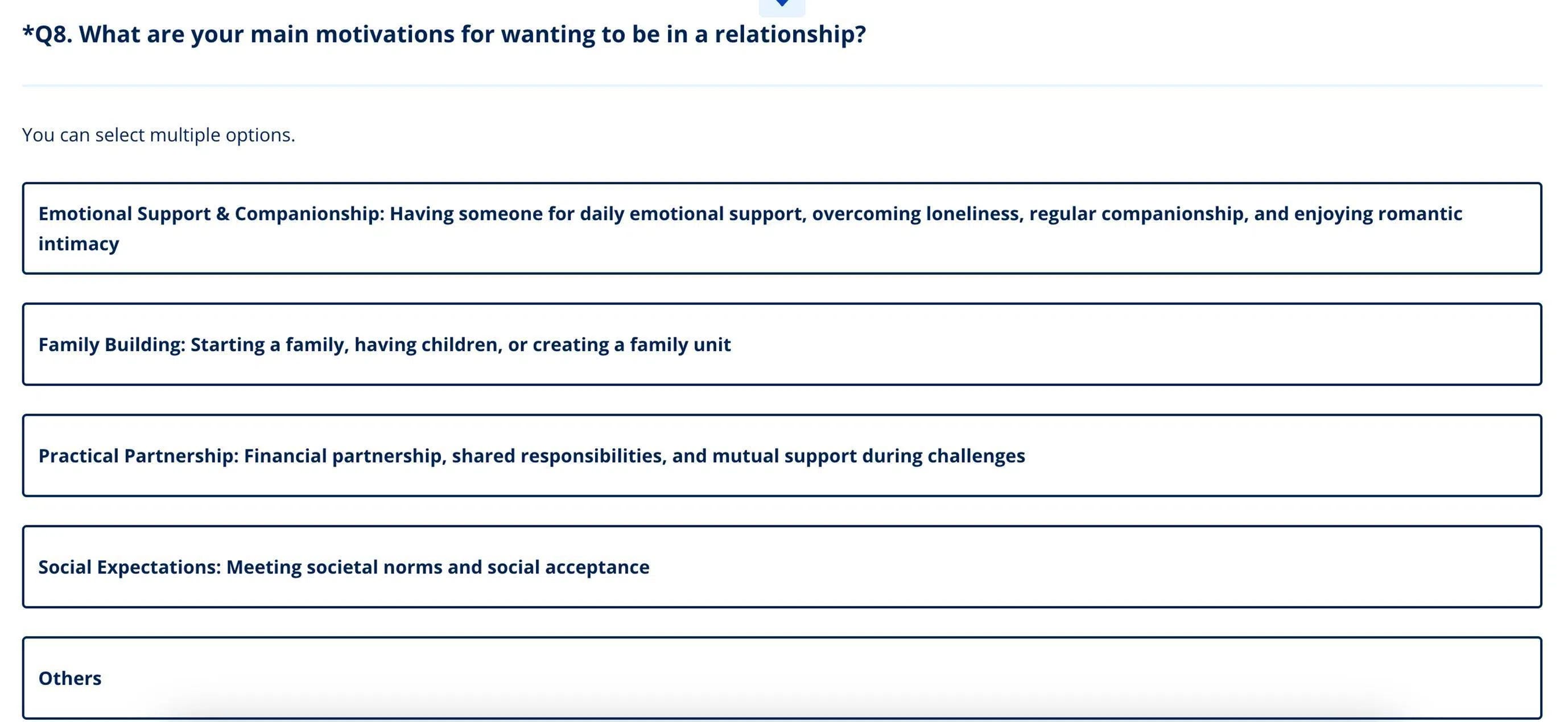
The options included “overcoming loneliness”, “creating a family unit”, “financial partnership”, and “social expectations” but not, you know, LOVE. As in, the kind of love that isn’t selfish and totally centered around what your partner can do for you.
Perhaps that’s filed under “other” or “enjoying romantic intimacy”?
This is not me saying that shared values are not important. Studies do indicate that the couples that do end up together tend to have similar values. But that is not the same as screening your partners based on adherence to your ideas of what hobbies, love language, or dietary preferences they should have.
What I am saying is that perhaps, we shouldn’t be treating our choice of partners with the same mindset as how we approach schools and jobs, through the lens of competition in pursuit of optimal choices. Or through an algorithm used for matching people to their schools and workplaces.
Incels and the gamification of online dating
To be clear, I do think that this GovTech pilot programme is an admirable initiative. More experimentation in the public sector is always a net positive, and I hope this doesn’t read as me just clowning on a good faith attempt at fixing what’s wrong with online dating.
There are clear benefits to a model of online dating driven less by profit incentives and shareholder value, and driven more by user needs.
Notably though, this isn’t the first attempt at a state-run matchmaker. I find it hilarious that the previous effort, the Social Development Unit (SDU), has a Wikipedia page with a section dedicated to how people used to joke that it stands for ‘Single, Desperate and Ugly’.
The similarities between FirstDate and the SDU (and later, the Social Development Network) go beyond the involvement of the state. As this 1992 article from American libertarian magazine Reason points out, the SDU too analysed its matchmaking pool’s responses to questionnaires to compute a list of compatible dates. The Singaporean urge to quantify and computerise is a long-running one.
Still, if the goal of FirstDate is to make a better product than dating apps, they’ve already succeeded (for hetero sinkies aged 21 to 35). But, mind you, the bar is in hell.
The dating app industry has long made the exploitation of the artificial scarcity that it creates in online dating its primary source of revenue. This is coupled with the perception of perpetual abundance, the idea that there’s always somebody better out there, so it can keep dangling ever more matches and paid-for features to woo them with. All of this so Tinder can milk as much profit out of you as possible. Online dating is the archetypal example of enshittification.
I’m not convinced that a better algorithm is the solution (though I’d be glad to be proven wrong). Really, the clamouring for it is symptomatic of our redpilled and incel-inflected times.
The truth is that we don’t really know what exactly makes love work, such that we can articulate and implement it on a societal scale. It’s too messy, too complex, too idiosyncratic, and too human. Anyone who claims otherwise probably has a course to sell you on negging and pickup artistry.
This is why even spending US$65,000 on the highest-end matchmaking is not a guarantee that you’ll find love.
The techno-solutionist idea that an algorithm will solve love is borne of the same mindset from which inceldom springs. This is a narrative that permeates so much of the online discourse surrounding dating today: I bought the meals, spent so much time offering my shoulder to them, gave so much of myself to them, and they still chose someone else. This entitlement feeds into the self-victimisation: they’re all just gold diggers, people only value appearance, nice guys finish last.
People feel entitled to love from the people that they want, seeing others not as ends in themselves, but a means to achieving some long-for happiness. This worldview is so persistent precisely because of the inherently market-driven logic of online dating. In today’s social culture, this logic has become inescapable, manifest in how formerly fringe terms like looksmaxxing and looksmatching have entered the mainstream lexicon.
It is no coincidence that the hierarchical and self-commodifying nature of dating apps (and algorithmic matchmaking) is frighteningly similar to the hierarchical and deterministic worldview of incels and pick-up artists. (I want to scream: love is not a rank ordered list!!) After interviewing incels and former incels, I came away with the sense that yes, the solution is to go outside and ditch dating through a screen.
Rather than creating an off-ramp from a system of alienating self-commodification, FirstDate creates another platform for people to game.
There’s a good reason why Singaporeans are still – according to surveys by the National Population and Talent Division at least – more likely to find love through offline methods (their schools, workplaces, family friends) than online channels.
This is not only because these are situations where one’s stated preferences melt away to reveal their actual personality, but also because boredom, hardship, and chaos are the things that reveal whether your personalities actually work together. This is otherwise known as chemistry.
What’s worrying is that all of these offline methods (with the exception of social activities and places of leisure) are declining as channels for meeting prospective partners. That people are increasingly meeting their partners through social activities is a promising sign though.
In my view, the problem of dating in Singapore has less to do with what technical tools are available to us, and more to do with the decline of the nation’s third spaces, the nightlife scene, and places for people (both the youth and those aged 36 and up) to just be. A better solution would be to invest in these spaces.
Make dating fun again
The urge to quantify compatibility is understandable. This is Singapore after all, a country where we just can’t resist tying our self worth to a score. But, even a casual look around you at the couples that do work would tell you that this impulse to quantify defies logic.
If the man I’m marrying in January were to fill out this questionnaire, he’d probably fill it out like an introspective soft boy and express a preference for softspoken people that fit into that lifestyle.
If I were to fill out this questionnaire (as a queer person, this is strictly a hypothetical), I’d fill it out like a demon twink that wants a partner in crime to party with all the time.
The result would likely mean being matched up to somebody like our exes.
Instead, we met over Grindr, an app where one has little to go off of besides appearance, distance, and sexual compatibility. And over the next year, he became my plus one to all the nightclubs and bars and parties I write about as a lifestyle journalist. And he, in turn, drags me out to the fandom conventions and game jams that he loves (and that I admittedly am lukewarm on). I fell in love with him on the dancefloor, and he fell in love with me during the quiet times in between.
I’d argue this surprise and unpredictability is key to finding chemistry.
And, also, that there’s something deeply unsexy about someone setting you up with someone who is perfect for you on paper. We spend so much time in the rat race, surely love should be the one space free of optimisation at all costs.
So, here’s my proposal: Let’s fund culture clubs, theatre groups, video game conventions, music festivals, whatever!
Instead of promoting them as places where people can come to meet their prospective partners (you’ll be accused of trying to resurrect the Single, Desperate, and Ugly club), let’s bet that happy and fulfilled people with friends and access to thriving third spaces will couple up if they want to.
Instead of ramming pro-fertility rhetoric down our throats, let’s focus instead on eroding the barriers that so many people feel when it comes to being part of a community, like the steep cost of just existing in public in capitalist Singapore or the exorbitant cost of late night transportation or the reality that it’s hard to have friends over (let alone a prospective date) when one is expected to live with their family until their 30s.
Let’s focus on broadening the extremely narrow horizon of social possibility in Singapore, where everyone complains that there is no nature, no culture, and nothing to do but eat and sleep and travel. Is it any wonder that an earlier prototype of FirstDate places such a big emphasis on free first meals? What else is there to do?
If this sounds like a radical solution to you, it’s only because you haven’t been paying attention, because it’s already happening.
Take a look at the sober rave (and friendship festival) at Funan co-organised by the Ministry of Social and Family Development (MSF) in 2025 that most participants probably didn’t even realise was a government-led operation.
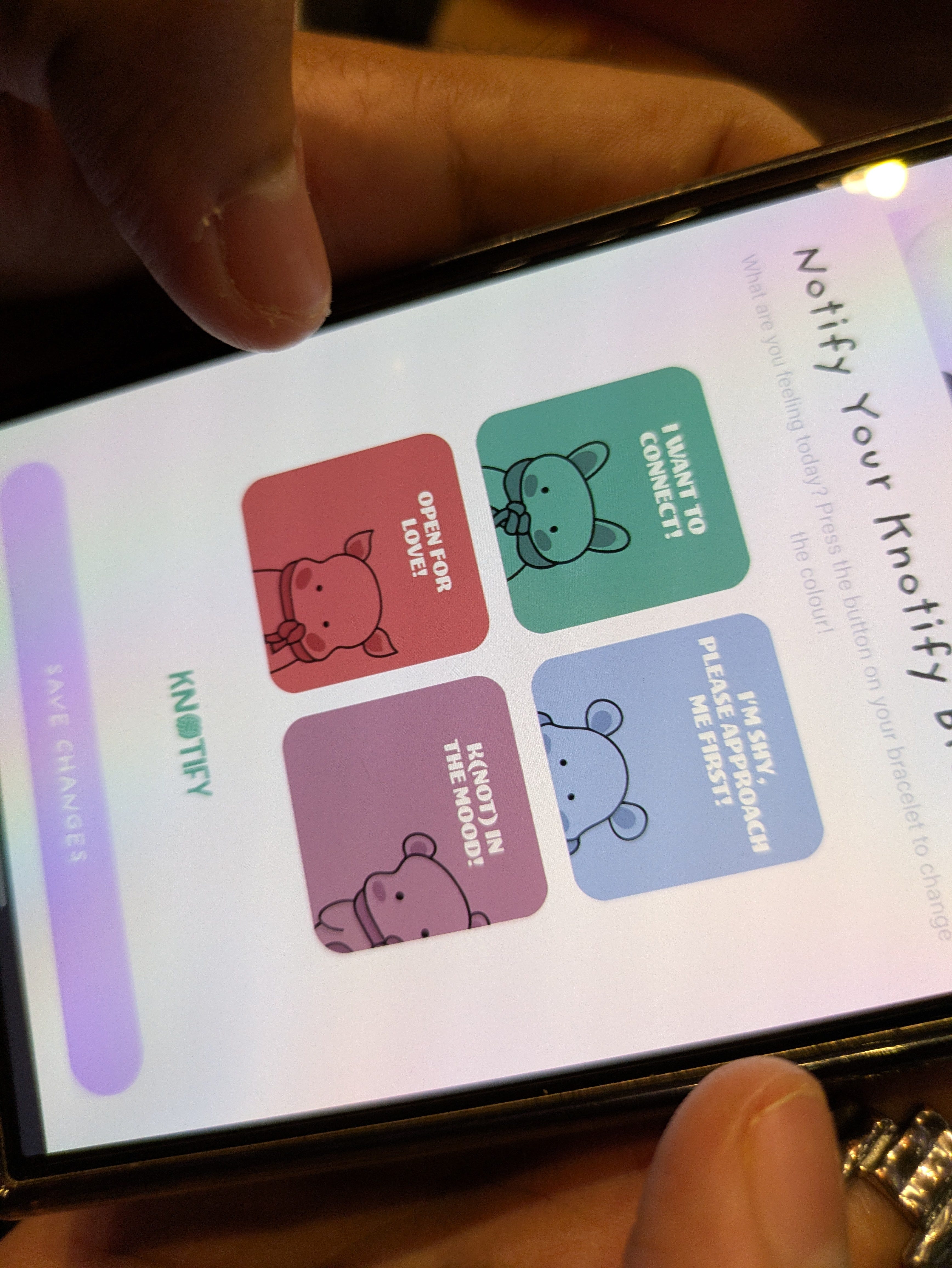
It offers a fascinating window into what government-funded culture activities that are also not-so-secretly trying to get people to make babies could look like. Festival attendees were literally handed out bracelets to signal to other attendees their openness to a relationship, and yet, the reception from everyone I spoke to was almost unanimously positive (towards the event, not the bracelets).
In a time of shuttering nightclubs, bookstores, theatre groups, and whatever else you’d consider a common social space, I’d argue that this kind of support is badly needed. And, I would wager that MSF’s bet on third spaces is more likely to produce happy couples (and babies, if you care about that) than this.
If we must introduce some kind of app-based solution, have people match themselves to the things they want to do, rather than the people they want to have. I would argue that this is far more revealing of one’s character than a questionnaire, and also, far less alienating.
Let the cosplayers meet their kindred souls at the government-funded con. Let the book lovers meet at the talk at the indie bookstore. And let the nightlife enthusiasts meet at the sober (or not so sober) rave.
And if you don’t get the love of your life out of it, well, at least you’ll have had a good time doing it.
This is the most hilarious thing I heard the whole week. I don’t know whether this is a brilliant or terrible idea.