

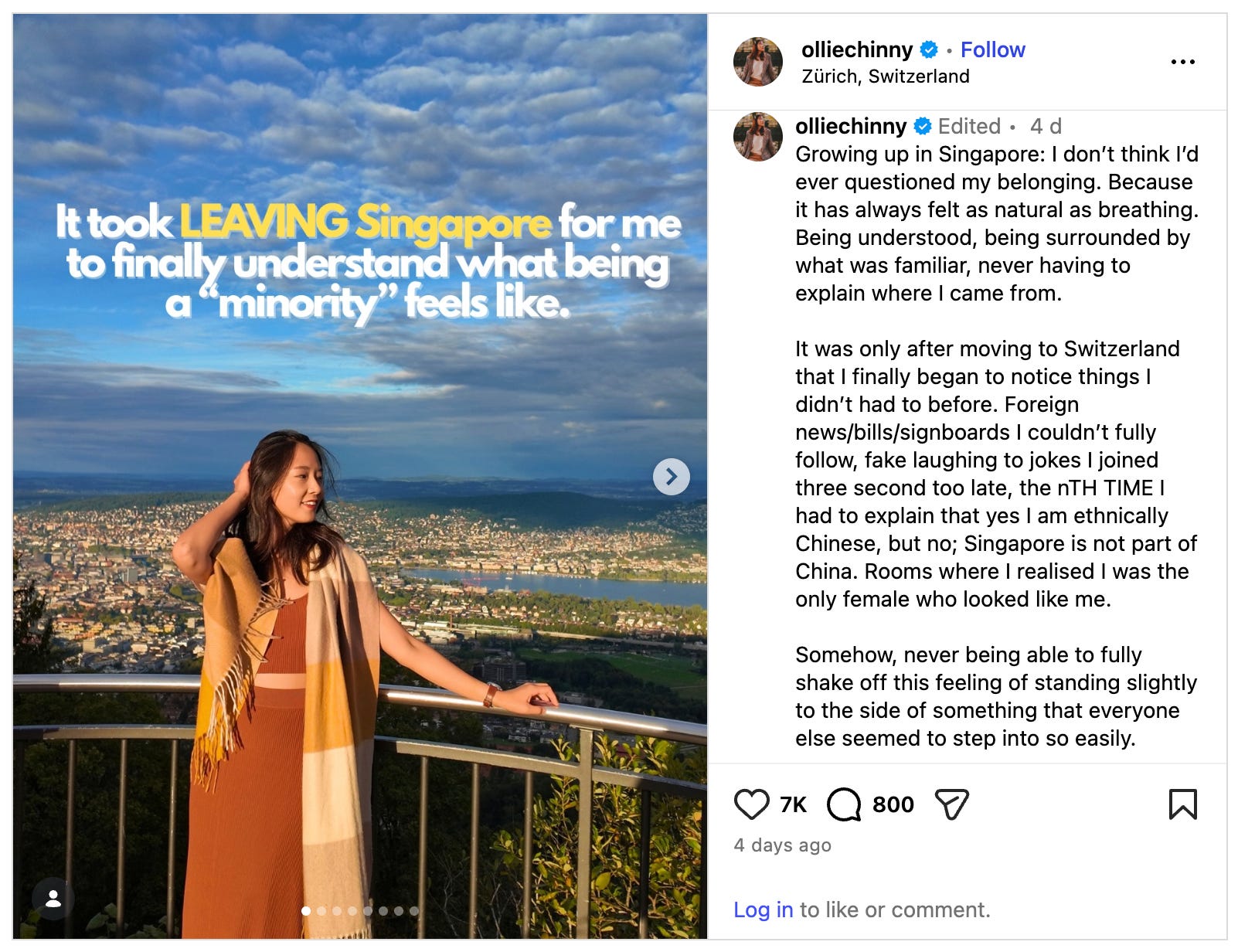
How many Singaporeans have at least one close friend of another race?
According to a 2024 IPS survey, just over half of the 4,000 Singapore citizens surveyed (53 percent) said they have at least one close friend of another race.
This marks a slight decline from 2018, the last time the survey was conducted – and a slight increase from 2013 (when that figure was 45 percent).
It’s a figure that also partly explains why some Singaporeans can make faux pas like stating that moving to a Western country has taught them to be more empathetic towards racial minorities in Singapore.
“So... this is what it feels like to be not fully seen,” reads a viral post by Singaporean influencer olliechinny, who is based in Switzerland. “This was probably also how my Malay and Indian colleagues might have felt back home.”
It was the experience of not being able to follow conversations in a foreign language in Switzerland that made her realise how exclusionary it is to switch to Mandarin in Singapore when those who can’t speak it are present.
This satirical response captures perfectly what’s wrong with it:
But, okay. Let’s put aside the bizarre influencerpilled format of her post (which suggests that racism and curating a beautiful aesthetic are equally important).
Let’s also put aside how she tagged everyone from Mustsharenews to Mothership to the Singapore Global Network, likely with the expectation of receiving a ton of congratulatory praise for making this post.
What’s crazier to me is how blatantly someone can state that they’ve experienced racial privilege and discrimination, without ever using the words. As this influencer readily concedes, she has been blinded by how Singapore approaches race.
Frozen in time
Part of the reason why our discourse on race can seem so regressive is because our approach to race — exemplified by what we call racial harmony — has been frozen in time since the post-independence and colonial era that birthed it.
Racial segmentation was core to colonial rule in Singapore, and the post-independence years saw many responses to that (like the Ethnic Integration Policy). These efforts, seeking to create racial harmony, have also served to reify the importance of race, rather than diminishing it.
It is well known that Singapore’s immigration policy is race-driven and aims to preserve the (Chinese majority) ethnic balance of Singapore as it was during independence. This is despite how Singaporeans likely have more in common with our Southeast Asian neighbours than with immigrants from further abroad.
Such an approach cuts to the heart of why it is difficult to articulate a coherent narrative of race in Singapore: the idea that a Chinese majority and deeply racialised post-colonial policy is core to Singaporean-ness is at odds with the idea that we are one people regardless of race, language or religion.
While Singapore regularly trumpets its racial harmony as a defining feature of society, it is not that diverse when you look at it in the context of comparable global cities, rather than entire nation states.
46 percent of London identifies as black or minority ethnic (non-white). Over 60 percent of New York identifies as non-white. Singapore reports only the ethnic makeup of its resident population (excluding those who are neither citizens or permanent residents) – over 70 percent of which are Chinese.
Moves like the Ethnic Integration Policy have broken up ethnic enclaves, but at the expense of normalising Chinese, Malay, Indian, Other (CMIO) categorisation. Rather than moving us towards more nuanced or race-neutral alternatives, the differences between racial groups is rendered as an essential but always-threatening part of life in Singapore.
Residents here have long chafed at the overly simplistic nature of CMIO, which renders many groups unintelligible and many others apparently unsuitable to settle down here. Despite attempts at broadening our understanding of race, CMIO still remains the dominant way through which most Singaporeans understand and discuss ideas of representation and equity.
Many Singaporeans will also likely attest that the school was the place where their formative views on race were crystallised under a national education programme.
When we teach race in school, we often teach it as something foreign, exotic, and potentially dangerous. It is the source of racial tensions, big (race riots) and small (over the smell of food).
Singaporeans going through social studies classes may recall being taught about ethnic conflict in Sri Lanka and the Troubles in Ireland. When I was in school, the Troubles and the Sri Lankan civil war were ethno-religious bogeymen for what happens when you let race occupy too central a space in society.
I remember having the displeasure of sitting through an interactive theatre skit where actors roleplayed as a racist Chinese person complaining about the smell of their Indian neighbour’s cooking — and being expected to give equal weight to both of their viewpoints.
Under the actors’ egging on, other impressionable minds and I were encouraged to think of ways that we could harmoniously avert conflict. Calling someone out was not the answer.
Harmonious speech?
And so, despite the way that race clearly permeates so much of life in Singapore, our discussions of it remain frustratingly limited — often through a lens that too readily ignores minority experiences.
When some Singaporeans call attention to the discrimination that often occurs in the job and housing market, where landlords and agents state “Chinese only”, a common reaction is apologia: It might just be the company culture. The landlord had a bad experience with Indians. Customers prefer to speak Chinese.
When people raise their frustrations over how businesses from China setting up shop in Singapore often lack signage or staff for English-speaking customers, there is little discussion of how it might be a consequence of policies that place an inherent value on Chinese-ness.
Those who question differences in representation or outcomes between races are accused of importing “critical race theory” from America, or seeking to cause discord.
In Singapore, race is paradoxically supremely important and yet unintelligible, marginal, and invisible in our daily discourse.
All of this explains why it’s not that surprising that half of the Singaporeans surveyed by IPS don’t have a close friend of another race.
The awful stereotypes described by the satirical post by the Punjabi Singaporean above — “when mothers used to tell their children that we are out to catch them” and “when they cover their noses as soon as we stood near them” — are impossible to effectively call out in a society that simultaneously believes that race doesn’t matter and that actually, racial difference is one of the most dangerous threats to social cohesion in Singapore.
It also explains why a Singaporean influencer had her come to Jesus moment about racism in Switzerland, and expected to receive praise for her incredibly lukewarm takes. Having so rarely seen such discourse in her daily life in Singapore, the vaguely liberal Singaporean now styles herself as a champion of minorities for saying hey guys, let’s speak English instead of Mandarin.
It’s kind of funny to me that Switzerland is also one of the examples used in Singapore textbooks. Unlike Ireland and Sri Lanka, it is raised as a positive example of how a nation manages diversity. And yet, it appears to have been so unwelcoming that it caused at least one Singaporean to totally reassess her views on race.
In her own words, having studied in a Chinese school and gone to a Chinese church, she “grew up in an artificially homogenous environment”.
“I had very little interaction with peers from other races or cultures. Belonging was not something I had to think about, it was given.”
That we have elite schools that focus on a bilingual Chinese-English education is itself one of many examples of how Singapore continues to have and entrench racially stratified and exclusionary parts of society.
These are everyday racial realities that we all recognise – but are not supposed to talk about.
It’s sad that the only times we do get to speak about it are during these moments of faux pas, when the blindness towards race becomes so extreme, it simply cannot go unacknowledged.
You can care about race and social issues without turning them into performative content for engagement.
There’s something deeply disingenuous about criticising Singapore’s racial discourse while simultaneously packaging the conversation for virality through MustShareNews and Mothership tags and social-media outrage mechanics.
Serious conversations deserve seriousness, not engagement optimisation dressed up as moral courage.
At some point, “woke” signalling without nuance stops being meaningful advocacy and starts looking like self-serving content creation.
The influencer tagging Mustsharenews and Mothership expecting congratulations for realizing in Switzerland what Malay and Indian Singaporeans have been living with at home is such a perfect encapsulation of the whole problem. And the CMIO point is well put — a categorization system built for post-colonial management that was never updated, treating racial difference as simultaneously the most dangerous thing in society and something we're not supposed to discuss directly. Two ideas that can't coexist, officially enshrined for decades.