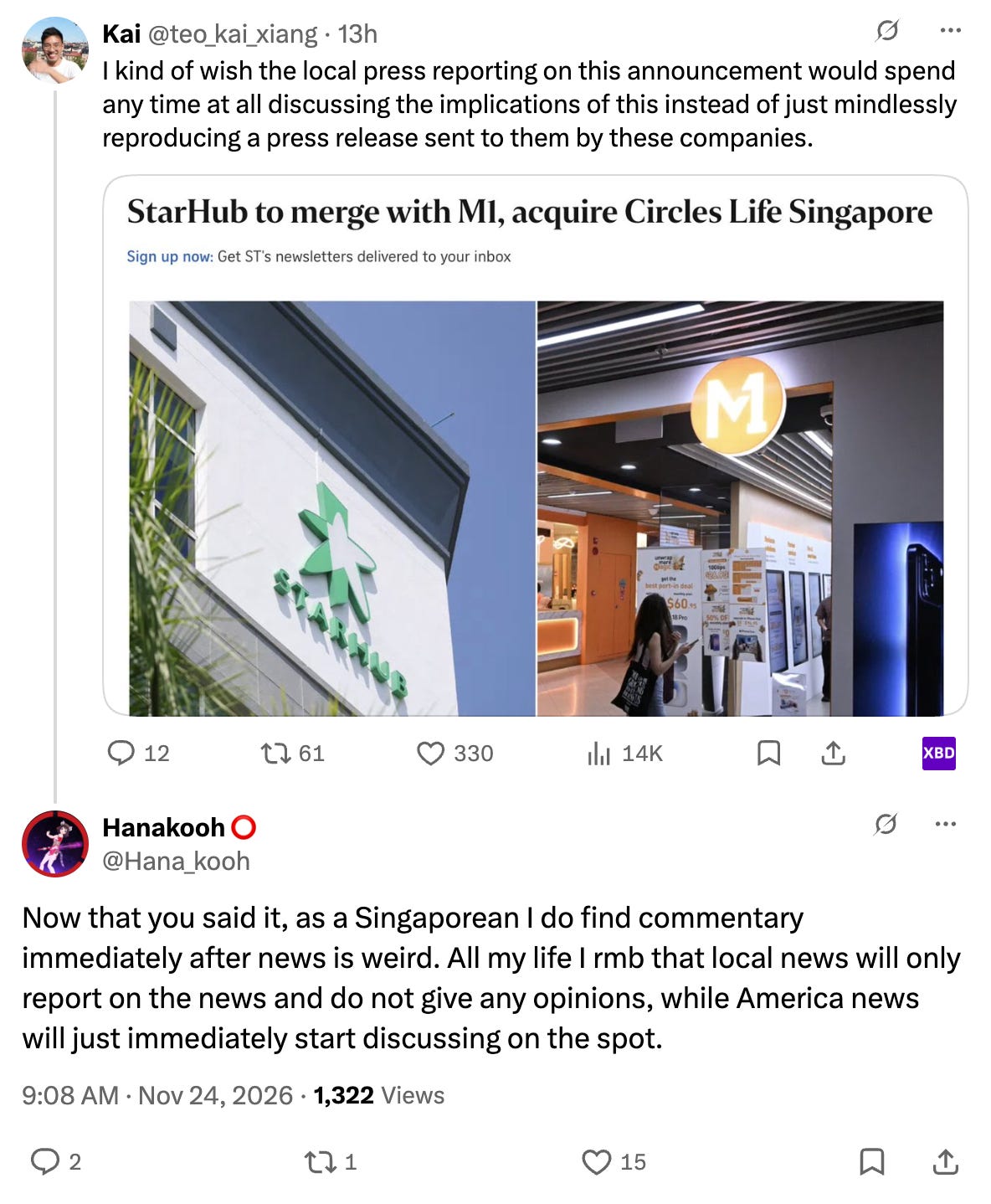
At the Straits Times, are we journalists, or are we glorified PR people?
A rant against lazy reporting by an ex-journalist.

StarHub is merging with M1 and acquiring Circles.Life Singapore. In one fell swoop, the country is going from four telcos to three (leaving only StarHub, Singtel, and a scandal-ridden Simba), while eliminating one of the key Mobile Virtual Network Operators behind driving mobile data prices down in Singapore.
Is this level of industry consolidation cause for concern? What do the experts think? What do their competitors think?
If you got this news off of Singapore’s national newspaper, the Straits Times, you’re out of luck, because their story appears to largely be a reproduction of a press release sent to local news outlets.

There is no expert commentary (unlike CNA). Instead, all the comments come from just three people: StarHub’s outgoing CEO Nikhil Eapen, StarHub’s incoming CEO Matt Williams, and Keppel CEO Loh Chin Hua (Keppel is M1’s parent company).
And according to Eapen, “consolidation is the answer”.
As for whether the public has any cause for concern, worry not. The story explains that there are no plans to cut headcount and that “the company will focus on value creation for its shareholders”. Really, the story goes to great lengths to spin the move as a positive for all involved.
The only value-add (that probably didn’t come from the press release sent to journalists about the merger) was pointing out that consolidation has become an industry trend. StarHub began the process of buying out another competitor, MyRepublic, in 2022.
Is this news? Or is this glorified public relations? It would be one thing if this was an isolated incident, but it isn’t.
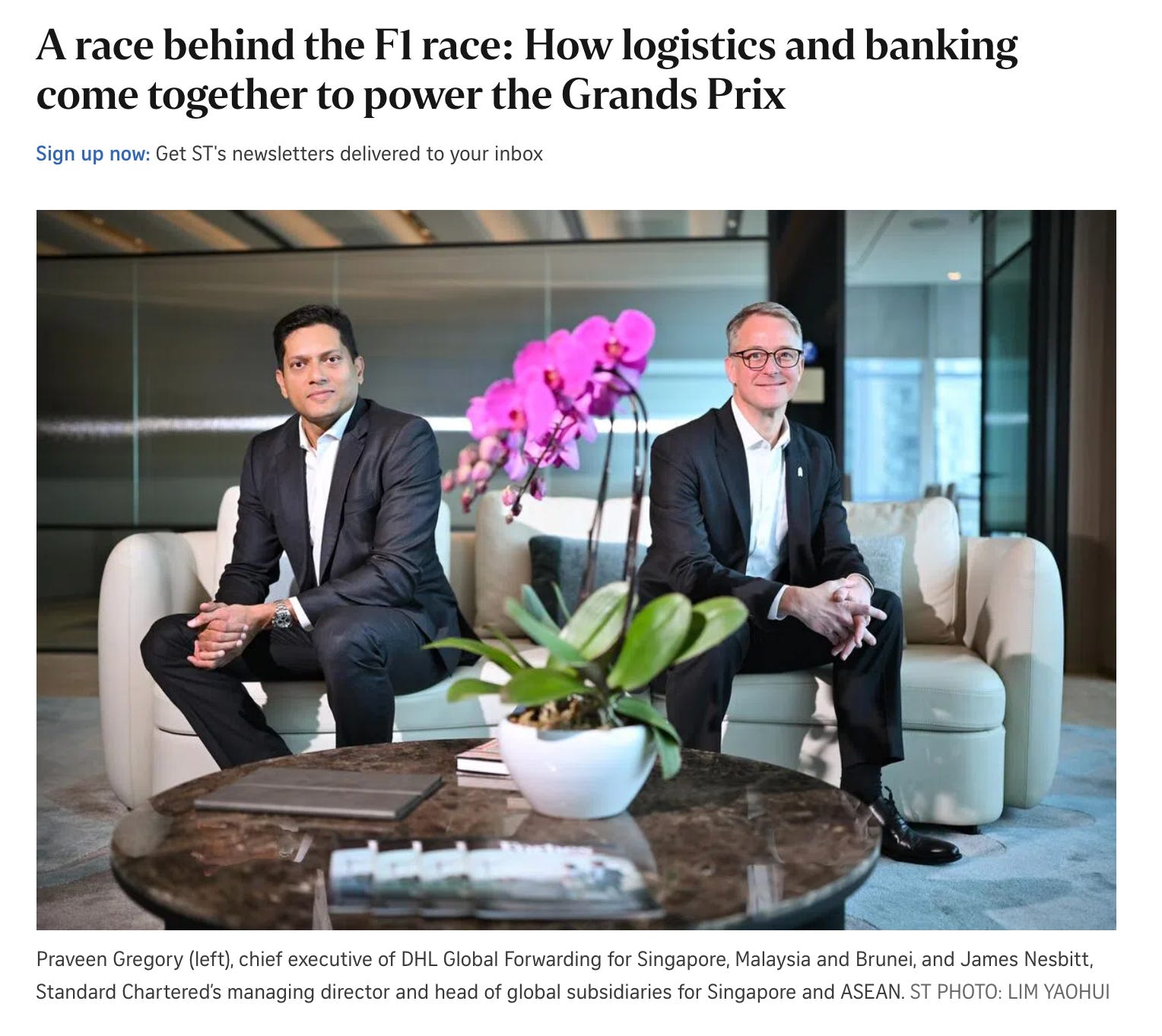
Looking back at previous writing by the correspondent responsible, so many of their headlines feel indistinguishable from the kind of press release headlines that public relations professionals would pitch to me while I was working at ST. Headlines like…
A race behind the F1 race: How logistics and banking come together to power the Grands Prix
Nasdaq-listed HomesToLife lands SGX dual listing amid rising global demand for custom furniture
Even billionaires need human connections in AI age: Business Network International CEO
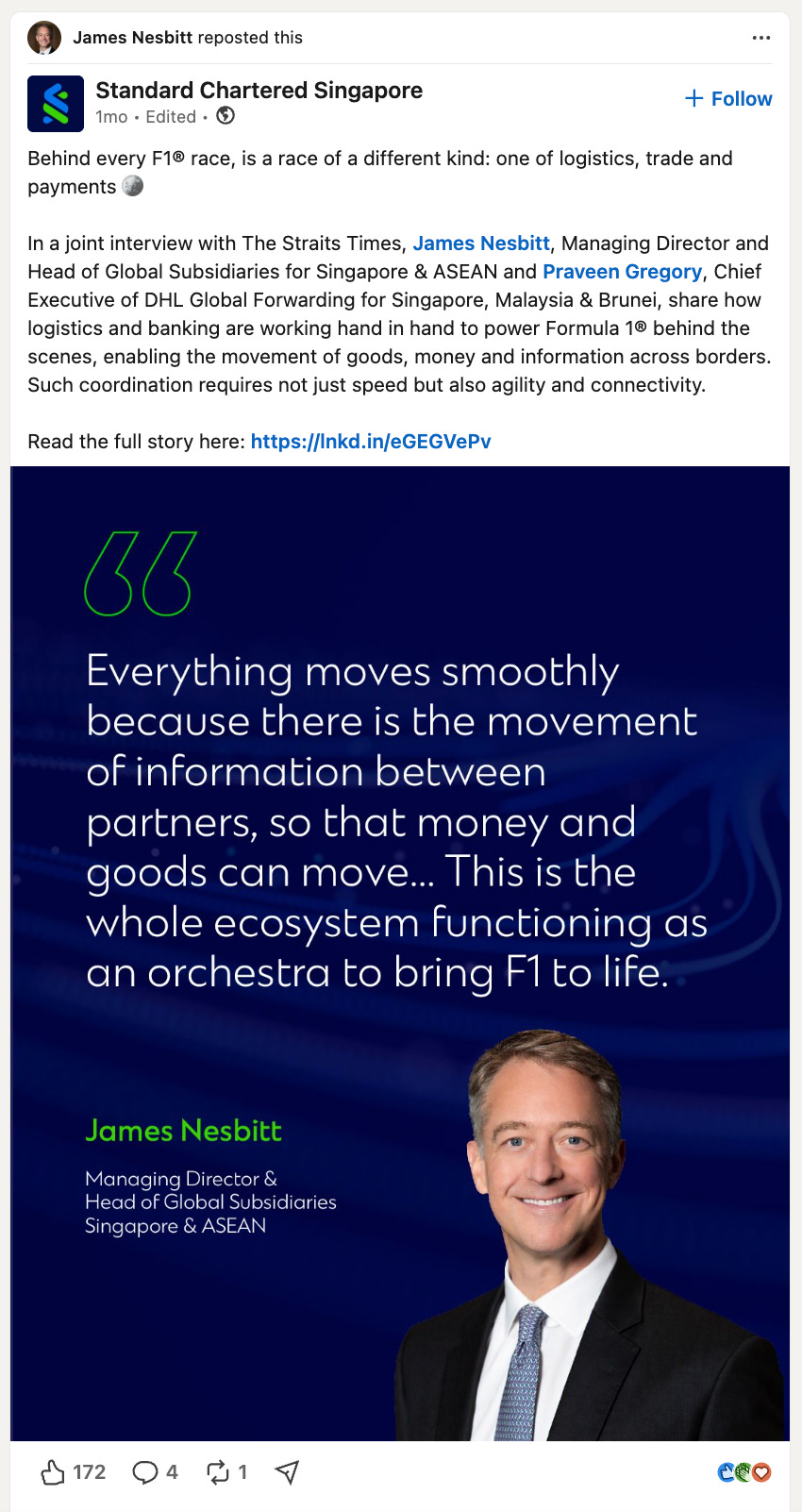
Notably, all of these stories seem to feature only sources from the companies featured, talking about themselves in glowing terms. The F1 story features executives from DHL and Standard Chartered on its cover image and reads like a sponsored story a company should pay for. The story about the HomesToLife Nasdaq listing only features comments from HomesToLife’s CEO as well as important gems like “the company has 20 different types of fabric and 10 leather options.” (This wouldn’t even be good material for the press release.) The last story dedicates over 1,000 words to an interview with one person, a CEO promoting their own company, with totally unbiased insights like “more firms from AI-related sectors have been increasingly expressing interest in joining the BNI network” (no data is available to back this claim).
When I studied journalism in Singapore Polytechnic, one of the first things we learned is the importance of understanding what the value of a story is to our reader, the person journalism is supposed to serve, not the people we are interviewing. I genuinely could not tell you what the value of these stories are to anybody who isn’t the executives from DHL, Standard Chartered, HomesToLife or Business Network International (and who likely tooted their own horns about it after on LinkedIn).
Worse, these stories violate the journalistic principle of impartiality, by uncritically broadcasting the views of a story’s subject, without trying to find a balance of perspectives (like someone who does not have a vested interest in presenting their company, the F1 race, or the merger as a positive for all involved).
ST’s story on the StarHub-M1 merger goes into how the company doesn’t plan to do any layoffs, and that consumers should not expect pricing changes in the immediate future. These are points echoed in a follow-up ST story published about 4 hours later by a different reporter after the news broke. The one note of negativity comes near the very end of that story, where a NUS business school lecturer points out that the reduction in competition means that consumers should expect less promotional discounts and data giveaways.
Talk about burying the lede. This is immediately followed by an assurance that cost savings from StarHub and M1 streamlining duplicate mobile equipment and IT systems “may even” be passed on to consumers, and that consumers “may even benefit from telcos differentiating their products and services through bundle deals across mobile, broadband, roaming, entertainment, cybersecurity and enterprise digital solutions – without engaging in a price war”.
Maybe it’s just me, but I would have led with the potential impacts for consumers first rather than with the paragraphs of PR-speak, considering that this merger would lead to a combined entity with 4.1 million customers, according to ST. When the original story was updated 12 hours later, it was to add more comments from StarHub and Keppel. I would not have dedicated so much page space to benefits that “may” happen while allocating only a single line to the negatives that will happen as a result of industry consolidation. But that would also require writing the story from the perspective of a journalist thinking about what matters to their audience, rather than a glorified PR person turning a press release into content that flatters the subject of the story.
Okay, you might say to me, perhaps it’s just because this is business news. Journalism is reliant on access and connections. Maybe a journalist who covers business in a small city like ours doesn’t want to burn their bridges with one of the three major telcos. I feel like companies are unlikely to try and circumvent one of Singapore’s major news outlets when getting the news out, but having worked in this newsroom, this is indeed a defence that I have heard often from and about the people who cover the powerful figures and companies who shape life in Singapore. To that, I’d say there is no point to access if that access is used solely for narratives that these powerful figures and companies want you to say.
And, of course, this doesn’t even address the laziness when it comes to sourcing!
This laziness extends beyond the business beat to so many others at the Straits Times, but is especially visible when it comes to those whose jobs appear to primarily be converting press releases from businesses or the government into feel-good stories and announcements like…
Visitors to The Kallang can tap new tech tools to boost leisure experience
S’pore and Luxembourg working to deepen ties in quantum tech, AI, space, satellite communications
Unpacking the ‘I’ in MICE: Why global firms are choosing Singapore for incentive trips
I would be genuinely surprised if these stories were original pitches from the reporter rather than press releases or invitations from PR people, because they have such a “why on earth would anyone care about this” vibe to them that can only be explained by that. Why do I care that there’s a new “Deloitte sphere” at The Kallang? The story about Singapore-Luxembourg ties doesn’t even explain what deepening ties means (the headline and the story’s first lines are the only mention of quantum tech and AI), presumably because the point isn’t to educate you (the reader), it’s so a Ministry can check a box. The telltale sign, to me, is that “incentive trips” are an industry term recognisable to companies (and the PR people who work for them), but not to the average reader, to whom a phrase like “company holidays” would be more legible. These aren’t even the kind of breaking news stories that require immediate and urgent publication, and they don’t appear to feature any sources that weren’t fed to the reporter by the organisations that are the subject of the story (sources who obviously themselves have a vested interest in not burning bridges with said organisation).
As a journalist, I am well aware of the amount of pitches that we receive from PR people representing companies. Not all of them are terrible, but even the ones that are great are never so good that I would convert them into a story without doing additional sourcing and research of my own.

I want to add the caveat that obviously, what I’m saying doesn’t apply to all of the journalism published by the Straits Times - which is home to many excellent reporters (you know who you are). And if you’re a current or former colleague offended by what I’m saying, I wish you’d be more offended by the prevalence of this kind of shoddy and low-effort slush. And this is not to say that public relations work isn’t work, but a journalist converting press releases (or information otherwise offered up by PR people) into content just takes way less time and effort than actual reporting, because the actual work is being done by PR people!
It honestly drives me crazy that so many in my profession in Singapore would consider elements like balance and contrasting viewpoints and diverse sourcing (all also known as doing the work) to be optional to their work, when it should really be essential must-haves, without which a story maybe shouldn’t even be published. Is it any wonder then that so many of my ex-colleagues in the local media see government communications and public relations as the natural afterlife for someone who’s done with journalism? I would rather have a story go out with less comments than print a story with only the biased comments of someone with a vested interest in the story presenting them in a positive light - but that’s also because I do not aspire to one day work in the public relations teams pitching me their stories and have no qualms about burning bridges when that’s necessary.
However, I think the worst consequence of this is the impact on news literacy and literacy in general. A very common reaction I get from the folks I interviewed while working at ST is disbelief when I say no, I will not be letting you read the story ahead of publication so you can vet your own comments. (The frequency of these requests should provide a hint as to how frequently others give in to such vetting in Singapore when it would be considered a journalistic sin elsewhere.) To many Singaporeans (and especially those working at large companies or in the civil service), the news really is indistinguishable from PR. Worse, many workers at companies I wrote about (like Grab) express disbelief that their views will be accurately represented because they are negative. Many Singaporeans genuinely do believe that the press should be good press and that bad press (as in, news that involves confrontation or negativity) is not really the purview of prestigious outlets like the Straits Times and CNA, but rather, Mothership or opinion-heavy Rice Media. As journalists, we are responsible for entrenching a newsroom culture where, instead of speaking truth to power, we primarily work as mouthpieces of it.
Many Singaporeans have come to associate this feel-good, no-negativity, one-source and no contrasting viewpoints style with “objective” journalism from Singapore’s major news outlets. Some of them now think that this is what objective journalism is supposed to be! Singapore’s largest online community (r/Singapore) even appears to label all news that isn’t from ST and CNA as “tabloid/low-quality” sources. It is beyond dystopian that a marker of good journalism is how well it conforms to public relations norms.
But hello! The point of journalism is not to just report the “facts” that you are told, uncritically and without reflection. Good journalism should surprise, it should show the plurality of viewpoints that exist on the issues we care about, and it should hold important people to account. It is absolutely not about flattering people and putting a relentlessly positive spin on news about the government or businesses. And, it is absolutely not about churning out uncontroversial content that is indistinguishable from the goals a business would lay out when signing an agreement with their PR firm.
All of that is great public relations, but terrible journalism.
:0
Great work. Nailed the issue.