

Writing this story about Open Government Products (OGP), the little-known government unit behind ScamShield and Parking.sg, made me curious about how exactly one could compare different government agencies when it comes to work culture.
As it turns out, according to Glassdoor reviews, OGP — which had a rating of 3.9 out of 5 based on just over 40 reviews — rates higher than 60 government ministries and statutory boards, including its parent organisation GovTech, as of February.
Only 14 other ministries or statutory boards had ratings that equal or surpass it.
This analysis of Glassdoor data from February excludes the 23 organisations that had fewer than 30 reviews on the platform, leaving 58 in total with 30 or more reviews. This chart also excludes OGP as it is technically not a statutory board, but rather, a subsidiary of one, GovTech.
(Note: the above-mentioned figures comparing OGP to other organisations do include the organisations with few reviews.)
How does one make sense of this data? After all, not all scales were made equal. Here’s how these government agencies compare to some other sectors:
In banking: Most of these organisations rate better than UOB (3.2 stars, based on 1,788 reviews) and OCBC (3.4 stars, based on 3,511 reviews), but worse than DBS (3.9 stars, based on 2,814 reviews) and Standard Chartered (3.8 stars, based on 10,846 reviews).
In big tech: Most of these organisations rate better than TikTok (3.3 stars, based on 697 reviews) and Sea Group (3.4 stars, based on 258 reviews), but fare worse than Meta, Google, and Microsoft (above 4 stars). Grab comes in at 3.7 stars, based on 1,199 reviews.
Reviewers were also asked about whether they would recommend this company to a friend, which has a few notable key differences:
Before you read on, there are some important caveats with analysing employee satisfaction through Glassdoor:
Not everyone uses it, and as the platform’s value is greatest for those looking to leave their jobs (who must first post reviews about their workplace before being able to access salary data for other organisations), there’s definitely a negativity bias on the platform. Employees with grievances are the most likely to leave lengthy reviews (see below for a selection).
At the same time, while Glassdoor denies that companies pay to remove reviews, there are many users sharing online that their negative reviews were deleted.
The ratings are obviously less reliable the less reviews there are, and there is a pretty wide variance between the largest and smallest agencies.
Glassdoor aggregates ratings from all employee functions, which is another issue as different departments are likely to have different work cultures. Many reviews and ratings are also non-recent. Many studies have (unsurprisingly) found that one’s supervisor plays an influential role in determining work satisfaction and well-being.
Most importantly, there is no verification process to ensure that all reviews are legitimate (as in, left by actual employees or providing real salary data).
In essence, this is an interesting analysis, but take it all with a grain of salt. Still, with the public sector often being so tight-lipped about its inner workings, Glassdoor reviews provide some fascinating insights into its work culture.
What makes a government agency unsatisfying to work for?
What do the lowest-rated agencies have in common? According to reviews, the answer appears to be senior management.
On Glassdoor, employees leaving reviews are asked to give a rating on six different categories: compensation and benefits, career opportunities, work/life balance, diversity and inclusion, culture and values, and senior management.
Of the bottom 10 ministries and statutory boards (which were rated by employees at 3.2/5 or below), only one rated senior management a 3 out of 5 and above. Half of them gave it the lowest rating out of the six categories they were asked to rate.
The National Arts Council, the statutory board in charge of developing Singapore’s art sector, had the lowest Glassdoor rating among all organisations analysed. Quite fittingly, the employee review rated “most helpful” by users had a go at being poetic. Headlined “as clear as canal water during heavy rain”, this reviewer writes:
I thought of the review headline since there is a canal which is Geylang river that runs beside the office building, and whenever it rains heavily when going/leaving office, I realised that the muddy water depicts the organisation perfectly.
Most of the important discussions are held behind closed doors and drawn blinds, away from the prying eyes of the common people who do bulk of the work. The office supposedly has a ‘open door’ policy where employees are encouraged to go straight and talk to the directors whenever they have anything to raise, but 95% of the doors of the directors are closed, only 1 director practises this ‘open door’ policy but i am unsure if employees talk to him directly on issues.
The Singapore Food Agency, the statutory board overseeing food safety and food security, had the third-lowest rating. This “most helpful” review writes:
In summary, SFA is like the Titanic, sinking beneath the weight of unappreciative chaos, toxic office politics, career stagnation, and the departure of its brightest minds. Brace yourself for a workplace on the brink of implosion, where the best abandon ship, leaving behind a crew of the undeserving.
Meanwhile, for the Ministry of Foreign Affairs (the lowest-rated ministry), this reviewer writes:
You know that the situation is dire when some of the best mentors, Directors and Deputy Directors who have dedicated years of service in the hopes of advancing Singapore’s foreign interests, resign amidst physical and mental burnouts, in search of greener pastures where their talents and skills are better appreciated.
You know that the situation has further hit a bleak abyss when a new task force needs to be set up just to examine why the foreign service keeps on hemorrhaging talent, as if the reasons why are not already blatantly obvious to anyone in management who deigns to talk to your junior and middle management on the ground.
What makes a government agency beloved?
What do the agencies rated highest have in common? There were 21 agencies that received a rating of 3.8 and above.
In contrast to the worst-performing, and perhaps unsurprisingly given that this is public sector work, 15 out of these 21 agencies’ reviews rated either “culture and values” or “diversity and inclusion” highest among the six categories they were asked to rate.
I did not compile CEO approval ratings, as much of the information is frequently inaccurate (regarding who is currently in charge) or absent entirely, but the agencies with ratings and at the top of the rankings (MAS and CPFB) do share in common an over 90% approval rating for their CEOs, according to reviewers.
Still, given the aforementioned negativity bias of employee reviews, the reviews ranked helpful are still pretty negative.
CPFB, which is rated third-highest among the organisations in the dataset, had one 2024 review calling it “one of the worst government agencies to work at” because of, among other reasons, too many unproductive meetings.
That’s another reminder to take all of these reviews with a grain of salt, since Glassdoor aggregates all of their ratings across roles and departments.
The review rated most helpful for MAS, left in 2017, is critical of a MAS unit’s “bullying, women-hating environment” and recommends visiting the group you are working at before taking the job.
But what is this abstract “culture and values”?
Surely, compensation must play a role? While compensation was not consistently the top or bottom category for both best-performing and worst-performing agencies, I was curious about its impact, given the popular perception of civil sector jobs being an iron rice bowl.
The wage data available on Glassdoor for the role with the most reported salaries is another interesting data point, suggesting that compensation alone doesn’t fully explain the difference between employees’ views of their workplace.
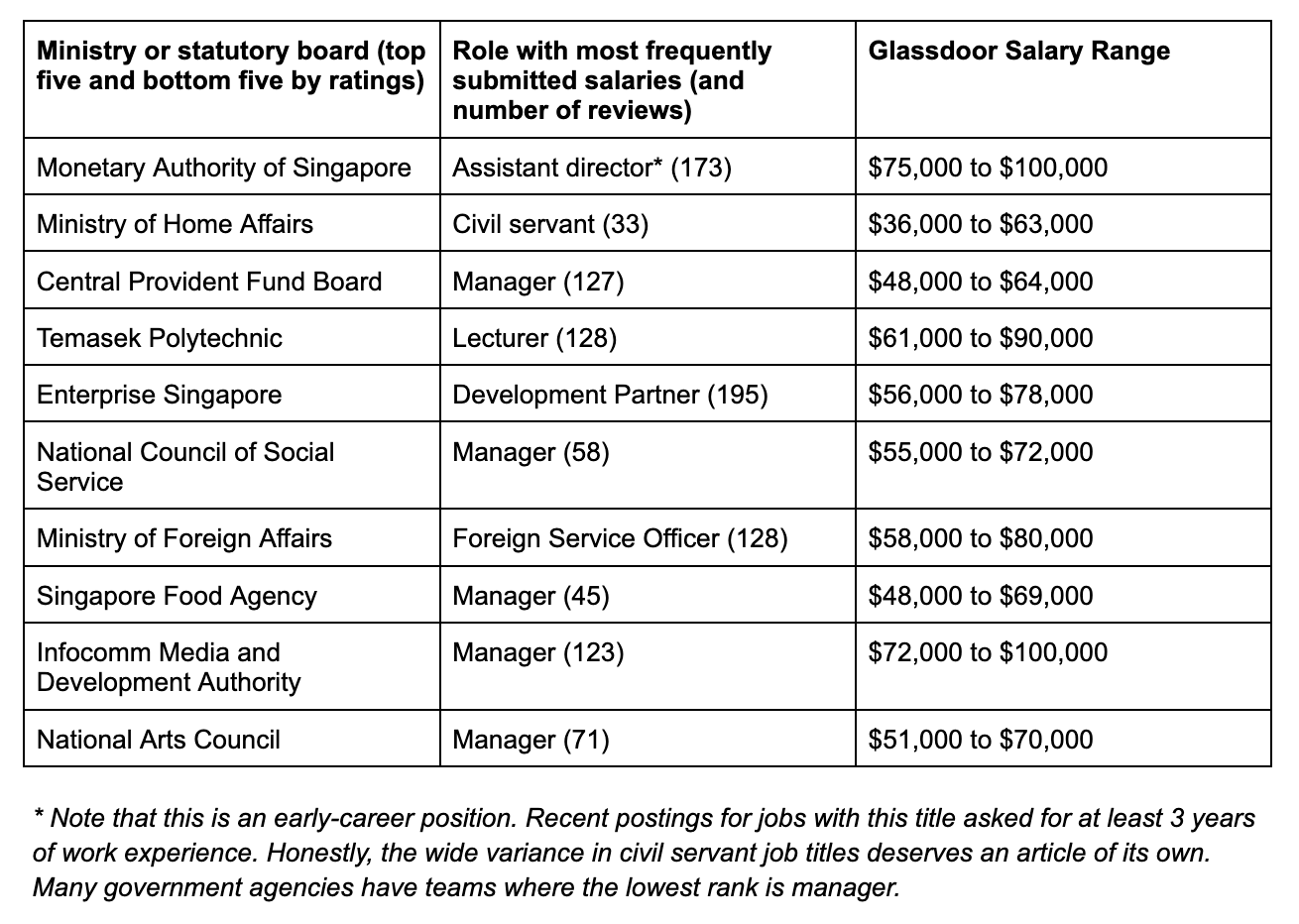
Obviously, what makes a workplace culture good or bad (according to reviews) is highly subjective. When comparing government agencies to the companies that rank well on Glassdoor (from DBS to Google), compensation and employee benefits clearly plays a role. (Though the tech sector’s reputation for better benefits does appear to be receding somewhat)
However, as many public sector roles have no closest private sector equivalent, my theory is that a large part of it also comes down to impact and public mission: Does the lived reality of working at this organisation match the expectations one has coming into it?
My interviews with workers at OGP, who are effusive with their praise, suggest that their organisational culture’s alignment with its reformist mission plays a key role. At OGP, teams are small and move quickly, have a higher degree of autonomy than at most public sector jobs, and have a flat hierarchy — all while working on some of the most consequential public tech in Singapore.
In contrast, at the Ministry of Foreign Affairs, the common theme among negative reviews appears to be, as one reviewer calls it, a “cumbersome and archaic bureaucratic structure”. Many reviewers say the work is meaningful, but is outweighed by long working hours because of work that always seems to be urgent, treatment from their bosses, and internal politics.
Meanwhile, at the Infocomm Media Development Authority (IMDA), one of the lowest-rated statutory boards on Glassdoor, the common theme among negative reviews appears to be indecisiveness from senior leadership.
Similarly, at the National Council of Social Service (NCSS), another low-rated statutory board, complaints revolve around frustrations with outdated technology, management, and hierarchy getting in the way of work.
Overall, these reviews seem to suggest that a mismatch between workplace culture/impact and mission explains the difference in organisational ratings for the public sector on Glassdoor.
If you enjoyed following me down this rabbit hole, subscribe or share this newsletter with a friend.
I think you've identified something very real. Biggest reason why I left suss is management, mismatch in expectations about mission and actual culture and the level of bureaucracy. This is despite me taking a 40% pay cut when I moved to nus. My salary now has just nominally caught up (i.e. without adjusting for inflation) to my suss salary after 5 years at nus.
Could you do a comparison for 2026 vs 5 years ago?